Whew! Well, we're starting to get back into our normal swing of thing here for the time being. Our eyes and ears have been obsessively keeping one eye on goldderby.com as award season reaches it's peak, and it's a big weekend for awards by the way, so if you want to win your Oscar polls keep an eye out on what wins what in the coming weeks, especially for the Guild Awards that are coming up. Not too much else going on nowadays, although speaking of Awards season, if you haven't seen the HBO Documentary "Casting By" from Tom Donahue, about the era where Marion Dougherty and others, really turning the job of Casting Director into an art in of itself, and I particularly wanted to focus on it because it's the one branch of the Academy, Casting, that for some reason, they do not give out an Oscar for. It's an art that's been shamefully passed over and dismissed and ignored, for many, many years, and this movie will really show the great talents and skills involved in casting, and-, while there's a lot of Oscar talk this year, it being the Whitest Oscars, how there's fewer women nominated across the board then in recent years, and stats like that, you really want to look at where sexism in Hollywood lies it's ugly head, casting, traditionally a field where the biggest and best names in the past and today are predominantly women, and the fact that it's still, really not treated with the same respect as other art and sciences in the industry, that is a long-standing shame of the Academy, and they really need to start fixing that soon. And I highly recommend that documentary as well.
Anyway, not too much else going on now; we're keepin' it easy as much as we can, but we got a lot of reviews of some of the Oscar-nominated films, and a lot more, so let's get to this week's RANDOM WEEKLY MOVIE REVIEWS!
BOYHOOD (2014) Director: Richard Linklater
✰✰✰✰✰
You know, what's suddenly ironic about Richard Linklater's "Boyhood" and all the acclaim that it's getting, is that, oddly, he has been ignored by most awards until now, and yet he has been making these kind of movies, not just for twelve years, but since he started making films. You know, like, let me explain it this way, I'm not a good director personally, I don't think I am, but I can teach somebody how to direct if I had to. I know all the steps, all the shots I'll want and need for a shot, know how to use a dolly, or set up a track, and when to use it, I can make show you how to make a shortlist, I can show you how to write out storyboards, but that's all technical stuff, okay. That's the easy stuff; it really is, but what Linklater manages to do, is to do all that, and yet, be able to invoke in us, responses, that almost personal and emotional, in ways that they're almost irrelevant to actual scene that's happening. And that's not just writer's feat, that's a directing accomplishment and it's not easy to direct. It looks good on paper, but it's one thing to write a scene where suddenly a little boy is told by his stepfather, out of the blue, that he's getting a haircut, and then to see his hair cut off, and then, see him trying to fake sick so as not to go to school, because of his new haircut, it's easy to get us, to care about this kid, (Actually that alone is hard) but he goes a step further, he finds a way to make us feel and make think, about other times, as a kid when, something is out of our control suddenly and we don't like how it is. At his very best, he's finding a way to seek out that reaction, that's beyond empathy, it's almost sense memory. In that certain scenes in "Boyhood" will work more than others for some, but that emotional response is what can separate the good filmmakers from the great filmmakers. This is why he goes about movies like this, and seeks out these new inventive ways of telling stories, starting with "Slacker" for instance, 'til that character meets someone else, and then following that character, and then to another character, and then enough... or "The Before Trilogy", where where we follow the same characters over nine-year intervals, or even something like "Waking Life", which uses animation to go explore the mind the resonance of ideas and dreams and other intangibles. Or, "Dazed and Confused" where we see the pointless actions and traditions that high schoolers partake in, seeking out a greater meaning, and not finding one,- he's capable of other great films, like a "Me and Orson Welles" for instance, (And even that one, is almost a study of genius from afar, so it also fits) but it's in these moments that distinguishes him as one of the great filmmakers of our time. "Boyhood" was a project he had been working on for years, 12 years in fact. He got the same group of actors and the same crew mostly, together for a couple weeks once-a-year, every year for twelve years, and then shoot a new series of scenes, following the life of Mason Jr. (Ellar Coltrane) as he progresses and grows from age 6 to age 18. This alone was a gamble, he could've easily used makeup or multiple actors to play the young characters at certain ages, and it would've been best just in case something happened to one of his stars over time, but that's not the story he's telling; it's not about them growing up, it's about the moments the characters are in now. Moments is the key word there. we gets the glimpses and we see and experience through his eye, but through his eyes, at this moment. His sees his mother (Patricia Arquette, who I just realized was never given a first name in the movie) go from rough divorce, to rough new marriages, to eventually finding her career and passion, only to look back on the path, complete distrought when she realizes at just how quickly and little time she had to experience motherhood, right at the time that Mason's father (Ethan Hawke), who he only sees periodically, struggles to fight his way back into his kids' lives, while also be able to become more responsible as a person, even if that includes, starting his own new family. "Boyhood" is really a special, unique accomplishment, not just as an experimental film, it's a great piece of cinema.
HOW TO TRAIN YOUR DRAGON 2 (2014) Director: Dean Dublois
✰✰✰✰1/2

I'm gonna confess that while I remember liking the first "How to Train Your Dragon", I don't particularly have great recall on the movie itself. That's not necessarily a fault of the movie itself though, I- I really think I just don't care that much for dragons actually. In hindsight, I guess it was kinda like "Avatar, Jr.", but considerably better than that; I remember the amazing shots of flight, which, really, using any kind of flight and animation, just go so well together anyway, you're already halfway there, but I'm starting to get the feeling that this is a far more thought-out and inclusive world than I first recalled. We arrive back, five years later in Berk, which was once the site of a barrage of dragons, to a world where dragons and the People of Berk live side by side with each other in harmony. Everyone's got their own trained dragon or two and they seem to sail through the skies in sheep collecting races. (I didn't catch the name of that new sport they invented, but the way I can describe it.) Hiccup (Jay Baruchel) and his rare, tamed nighthawk dragon Toothless, remain the closest of all the dragon/Berkian pairings, but his father, Stoick (Gerard Butler) still wants him, to take over as King one day, and is trying to get him interested in the more governmental affairs, but Hiccup and Berk, with their newfound freedom to take to the skies from their tiny island, continue to seek out more of the world, and becoming the unofficial island cartologists. As they continue to travel though, they begin finding more pirates, including Eret (Kit Harington) who's a hired dragoncatcher for Drago Bludvist (Djimon Hounsou, and whoever thought of that casting, kudos.) who's building a dragon army, in hopes of eventually taking over Berk. Stoick wants to lay back and prepare for war, but Hiccup is somewhat more democratic in his approach and decides to go seek out Drago and try and change his mind. This is a bad idea on two fronts, but before he even gets that far, he finds a secret dragon sanctuary encapsulated by ice, run by his (SPOILER DELETED) Valka (Cate Blanchett), who's been missing for year from Berk, having run off apparently in the middle of the fire in order to pursue her her conservationist approach to dragons. This leads to, probably the most surprising and most sentimental points of the film, and it was actually quite startling to see such a slice of true human emotion in this cartoon fantasy, and a lot more of it as well, as the story develops, as Hiccup has to resort to outfighting but also outsmarting Drago as he continues to gain control of the dragons. In many ways, I think "How to Train Your Dragon 2" was better than the original, and it really goes into the story and the world they create. This movie could've legitimately gotten an Oscar Nomination for Production Design, if they were to ever give such an award to an animated film, I was pleasantly surprised at how much I enjoyed "How to Train Your Dragon 2", and I have a suspicion that they continue to make more of these, and they could 'cause is a book series they're working on, by Cressida Cowell, that's quite popular in of themselves, I have a feeling these movies if they continue to be done right, can really grow and evolve the characters and stories more each time.
X-MEN: DAYS OF FUTURE PAST (2014) Director: Bryan Singer
✰✰✰

I went back to recheck my review of the last "X-Men" film, which I highly recommended, and this from someone who's never particularly liked the "X-Men" franchise, in any form really, and I even wondered about why they didn't make "...First Class" as the original "X-Men" film, since it so brilliantly shorthands and reveals the entire backstory and history (Granted, it involve a lot of rewriting of actual history, but nonetheless...) of the X-Men, which has always been the struggle of the series. There's so many characters to focus on, and they're fighting humans, and each other, and on top of that, the ranking always seemed weird, why certain one are more powerful and skillful than others. (I like Richard Roeper's joke, about how come Storm (Halle Berry) isn't the most important she, she's friggin' Mother Nature?!; I'm paraphrasing but still....) Anyway, now we get the, what is it, 7th, 12th, "X-Men" film? I don't know, but this one is "X-Man: Days of Future Past", or as I'm gonna call it, they're version of "Star Trek: Generations". Most everybody, including the director of the original few films, Bryan Singer is back, and now, both generations, are working together in a Terminator-esque time travel scenario, where Wolverine (Hugh Jackman) must travel back in through, eh, Kitty's (Ellen Page) hands, I guess, (Perplexed shrug) and sends him back to 1973, to prevent Raven/Mystique (Jennifer Lawrence, apparently Rebecca Romijn is not in the near future of this world?) from killing Trask (Peter Dinklage), who's the guy that begins the prototypes of the machines that would inevitably lead to the massive genocidal war between humans and mutants, along with the help of Mystique's DNA. In order to do that, Wolverine has to go find Charles Xavier (James McAvoy) the proprieter of his now now-mostly abandoned school and Beast (Nicholas Hoult), first to capture Magneto (Michael Fassbender) who's being held in a concrete prison below the Pentagon for having killed JFK, along with some help from Evan/Quiksilver (Evan Peters). In the future Magneto and Charles Xavier (Ian McKellan and Patrick Stewart) are together, but now, they're the MLK and Malcolm X of the Mutant worlds, and are still constantly at odds, even as they're struggling to be on the same side, and both care deeply about Raven, who's gone on a mission to kill Trask and then everyone else who's out to destroy mutants. Mystique/Raven, has in many ways always been one of the more interesting characters of the "X-Men", seemingly able to be anybody and therefore, anywhere, which means that she's quite a destructive force since it's usually too late by the time anybody realizes that she's even there. It also, unfortunately means that Lawrence has far more limited actual scenes than, say, the previous film which heavily focused on her, and that's problematic 'cause it makes us a little less capable of caring about her, and that, we get much less of Lawrence's performance that made Mystique's part so interesting before. And, if not mistaken, it almost seems like this movie, eliminates the previous films in the timeline, or...- I don't know, it feels and seems off, and mostly a force trick to bring together all these "X-Men" from different generations, for no real reason they need to be together, although it's continuity-wise, probably interesting to fans, but outsiders might be confused. Thankfully the last movie was so strong, I actually was more able to care and keep track of the characters for this one, although, it frankly was only about as good as the original films were in hindsight, and when events move to Nixon's Oval Office and beyond, it really starts to just get a little cartoony, not to mention that fact that "Watchmen" did that so much better. I think there's interesting themes and stories to develop in this series of "X-Men" films, but this movie didn't really seem interested in any of them. The more I think of these two latest "X-Men", they come across more night and day than I can remember. Perhaps there's some auteur theory at work here, perhaps this project was always just a cash grab no matter who was involved, but for waiting for so long to finally get "X-Men" right, and then to suddenly take multiple steps backwards, it feels more and more like a disappointment. I'm still, barely gonna be recommend "X-Men: Days of Future Past" although I'm quite tempted to drop this film to a negative review, because I was entertained and there are some really good sequences, especially in the beginning, and the Oscar-nominated Visual Effects are quite good, but I am gonna be harder on this series from here on out anyway, having finally seen how good it can be, to suddenly see it fall back when it really could've been special, it feels like a missed opportunity.
DAWN OF THE PLANET OF THE APES (2014) Director: Matt Reeves
✰✰✰✰1/2
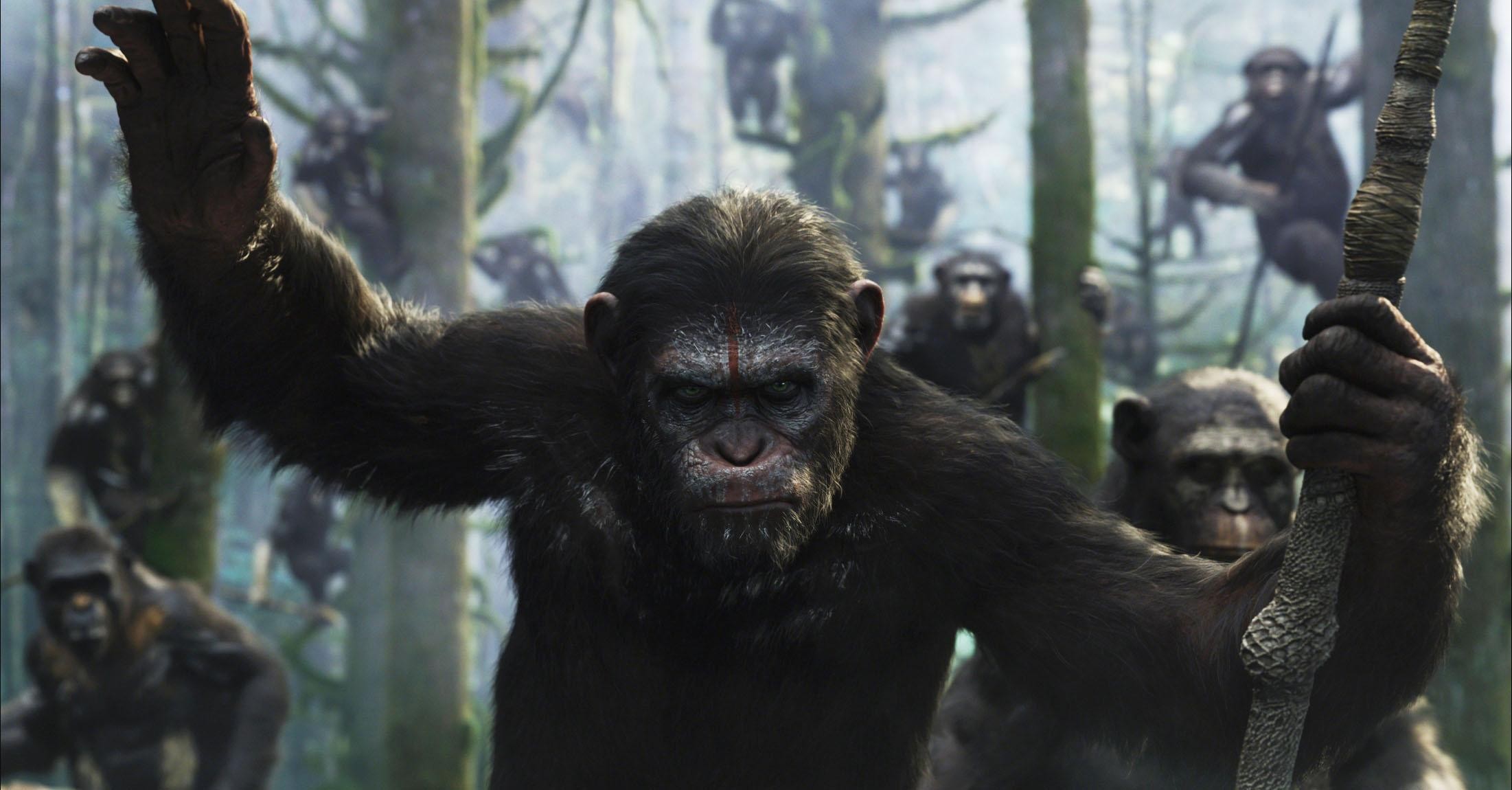
You know, there's time where, it is easy, to berate motion-capture and visual effects, especially when they're...- it's not that they're overused, but they're not often used to benefit the film; they're used usually, just to use them, and that's the truly worst reason to use special effects. Here they are used, to enhance a story. In fact they're used to tell the story, and I say that in the best possible way, and you know, if you go back to my review of "Rise of the Planet of the Apes", I barely recommended the film, and it was because of the effects mostly, I called it "The Flowers of Algernon" meets "Conquest of the Planet of the Apes", and really felt it was just overwrought and cliched, but I didn't think about that film at all while watching "Dawn of the Planet of the Apes", which, I guess if we're comparing it to the original franchise, is probably most similar to "Battle for the Planet of the Apes" the fifth film in that series, this is really a complete re-imagining. It's been ten years since the Simian Flu has wiped out much of the Human civilization, and apes have now taken over much of the world. Caesar (Andy Serkis) has formed a rising colony and has adopted, not just the ability to teach, but taught others through both sign and the spoken word. He's found a wife, Cornelia (Judy Greer) and now has a son, Blue Eyes (Nick Thurston) that he's teaching. Eventually, after a long absence, humans are spotted as a colony of survivors in the San Francisco area is in desperate need for survival and an abandoned hydroelectric dam if the woods where the apes has built their home, is their only hope for survival. The humans, led by Malcolm (Jason Clarke) and his wife Ellie (Keri Russell) tries to reach our to Caesar, yet unfortunate actions of some get in the way, on both sides, as feelings are still raw since the outbreak of the flu, and since Caesar's revolution. Caesar's known Koba (Toby Kebbell) since they were caged together for scientific research and doesn't trust humans at all, especially after seeing them stock up on extra weapons. Meanwhile, Dreyfus (Gary Oldman) and Carver (Kirk Acevedo) are among the many humans who don't trust the apes, and Dreyfus is apt to prepare for war, after it was their disease that eradicated the race, and many are still worried if they might be subject to remnants of the flu, despite most evidence that suggests they're immune, or that the disease itself is eradicated. The original "Planet of the Apes" movies were achievements in make-up and as they continued, they dared to espouse an alternative Darwinian timeline. Originally, this movie seemed to be one that fought to also exist in that timeline thread, and while this might not be the most original work, it's an achievement of visual effects and the ability to use those to tell this story. It's truly an accomplishment, there's scene after scene, of just amazement that they were able to bring this film alive, and you know what, this really is an encompassed. It doesn't have the heavy-handedness of the first story, it's much less of the human characters than the first one, which was almost homage by way of re-working of the material, this one just feels like it's on it's own, knows almost nothing of the other movies, it barely knows anything of the last movie even though it's a sequel. It establishes two different worlds, it establishes them well, it doesn't feel overdone, it doesn't dwell on anything extra or unnecessarily;.... it doesn't necessarily get right to the point, but it knows where it's headed, it organically gets there and it doesn't feel like a force, and yes, it's apes and humans, and you can throw in, whatever real-life allegory you want to put in there, and there's more than a few but, it's doesn't rush into anything, it's a complex route it takes to get to the battle, where both sides are at fault and both sides are equally struggling to stop powers from the outside and inside. And Andy Serkis- last film, I wondered if he should've been considered the Lead Actor instead of Supporting where a few of the award shows put him, this is a Lead Performance, and it's not simply a retread either, this is as amazing a performance you can find this year. Yes it's the same character, but it's the same character, years later, in a different situation, having evolved from before. "Dawn..." is a cinematic marvel quite frankly. There's only one complaint that I will throw out there, in the beginning, and that's during the opening sequence of news reports, they have a shot of President Obama, giving a speech out of context, I wish they didn't do that, because I think when you're dealing with a mass human eradication, you want it to be as far away from a modern world timeline as possible and to have a real person there, who probably is among the dead, essentially now being a character, that felt unnecessary to me, this didn't have to be down-to-the-minute realistic, but that's a really minor issue amazing example of the real magic of cinema, letting us see a world that we couldn't normally see.
EDGE OF TOMORROW (2014) Director: Doug Liman
✰✰✰✰

(Singing)
I'm standing on the "Edge of Tomorrow"
And it's all up to me how far I go..
I'm standing at the Edge of Tomorrow
Today!
(Fading Echo)
Today, today, toda-
(Suddenly realizing people are reading as I sing this)
If you're my age, not only do you know exactly what that was, you actually thought that, when you saw the title "Edge of Tomorrow", and don't pretend you didn't, no matter how much we'd like to. Anyway, plotholes aside, "Edge of Tomorrow" is basically "Groundhog Day", but with aliens. That said, it was entertaining and Tom Cruise gives his best performance in years. He plays a former adman who becomes a military officer, who's job is to work the Sunday morning television shows and promote the military's inevitable dominance over this form of alien creatures that has suddenly begun to attack the world. America is preparing a Normandy-like invasion to eliminate these aliens. Plans are in action, but for reasons that have and are never explained, General Brigham (Brendan Gleeson) has the lifelong public liaison forced against his will into battle service. Instructions to his commanding officer, Master Sergeant Farell (Bill Paxton) that he'll be disguised as an officer, and making up a story, make sure you don't believe him. He's thrown into Company J, and sure enough, the invasion is an ambush, and Cage is killed in action. Then, he wakes up the next day, and it all happens again. Waking up arriving at the base, training for the first time, ever, and then dying on the battlefield. Each time, it continues, he tries to survive it, but without luck. Eventually, he manages to contact the one person who knows what's happening, Rita (Emily Blunt) one of the angels that helped them win a critical battle earlier. She went through the same time loop and knows all the rules and tricks and together, they work to try and decipher the next day, in order to best defeat the aliens. It's ridiculous, it's a gimmick of a plot and movie, but it's entertaining, I got to admit. It's a different enough approach to this time traveling story that it's interesting, and different, and inevitably, if you don't think too deeply about it, it's fun and entertaining, to see how they figure out how to get out of this, and it almost all makes sense in the end. It's also Cruise's best acting work in a while, and you, this is a bit of a dumb action movie, and yes, he's done a lot of these, but you know what, it takes a lot and he has to be convincing through a lot of different emotional and physical levels; this is secretly one of the better acting performances of the year. He has to play younger than he is, there's no real makeup tricks,he's got a lot of physical acting, he's got to be able to properly keep track emotionally while keeping track physically, while continually evolving, and discovering something new each time,... this is a far more complex performance than most will notice at first.
FRANK (2014) Director: Leonard Abrahamson
✰✰✰

The title character in "Frank" is a musical genius leader of an experimental rock band, almost all of whom's members were crazy to some degree or less. Not just regular crazy, clinically crazy. I'm sure one of them didn't at some point spend time in a psychiatric ward, but I can't remember which one, offhand, possibly the keyboardist who tries to drown himself before a gig later that night, but I'm probably wrong about that. Some of the details got kinda muddled through the movie, as they probably do during recording sessions sometimes. Let's start at the beginning though, our protagonist is Jon Burroughs (Domhall Gleeson) who's a fairly talented young keyboardist, but who's unfortunately not the great songwriter he tries to be. His best attempt, when he finally played it, turned out to be a Madness song. He stumbles his way into the band after their latest keyboardist's attempted suicide, after just barely mentioning that he's a keyboardist, and soon, he's apart of the band, and is recording with them on their next album. I should probably talk about Frank (Michael Fassbender) at this point. Frank is a musical genius, who has a giant paper mache mask on his head, similar to that of Chris Sievey's character Frank Sidebottom. He sings and performs, and mostly creates the music, and generally he's a nice enough guy, even willing to let those who he's talking to show what expressions he has on his face. However, he's somewhat controlled by his girlfriend and the bands' theramin player, Clara (Maggie Gyllenhaal, proving again why she's one of the bravest actresses around.) who's overprotective of Frank, even though she's never seen him without the mask. Neither has anyone in fact, oddly. As Jon, documents the recording sessions and the strange antics, there's the struggle within the band between unexpected success and mainstream appeal and what exactly those things mean, and what they can mean to Frank, as the crazy sessions are detailed on Jon's twitter, and earning enough fans to get an invite to SXSW. The other struggle that's more fascinating to me is that between Frank and Jon, as Jon wants to see Frank succeed, recognizing his talents; he's like a young Salieri getting a firsthand look at someone who's a natural musical genius, but he's touched with a Syd Barrett, Daniel Johnston-like struggles in his mind, and now he's surrounded by others with the same mental issues essentially. I think if there's a problem with "Frank" it's that it tries to go for too much of some of these conflicts, without really setting them up as well as probably possible, and that's a bit of an issue, and it kept the movie from really being able to be fully embraced, maybe that was part of the point. I might appreciate "Frank" more on multiple viewings, but it worked best for me when I started singling out the parts I particularly wanted to see focused on more, and I think that was a bit of the problem, but overall, very unique film, very good movie about music, and that tightrope between genius and insanity that all the great artistic talents straddle upon.
MAGIC IN THE MOONLIGHT (2014) Director: Woody Allen
✰✰✰✰

Living in a town run by Penn & Teller, I know a little something about pessimistic magicians. I’m also a fan of Noel Coward and “Magic in the Moonlight” feels almost like Woody Allen's attempt at doing a more Coward work. He’s returned to one of his favorite albeit less successful themes and motifs, magic. A magician names Wei Ling Soo (Colin Firth) who poses as a magician from the Orient that tours Europe as one of the world’s best magicians. Outside of that, he’s a Brit who’s known as one of the world’s great skeptics, often called upon to debunk the latest charlatan who claims to be some kind of psychic, this latest one sends him down to the South of France for, is Sophie Baker (Emma Stone), one that’s even fooled his closest friends and fellow debunker,… Howard Burken (Simon McBurney). Wei, who's real name is Stanley but goes by an alias when he gets to the southern France estate, is engaged and set to get on a Galapagos vacation with Olivia (Catherine McCormack) but the job option is too much to pass up. So they arrive at the Catledge's estate, near where his Aunt Vanessa (Eileen Atkins) lives. Sophie travels with her mother (Marcia Gay Harden) and she's currently planning seances for the family patriarch Grace Catledge (Jacki Weaver), plus, her nephew Brice (Hamish Linklater) has become obsessed with Sophie and serenade's her and indulges in her, head-over-heels in love. The thing is though, she seems to be stumping Stanley, she even figures out fairly quickly his real identity, and seems to pull things off out of thin air that she couldn't possibly have known, and soon Stanley's willing to put his lifelong reputation on the line, claiming that Sophie is indeed a real psychic. That's something that Woody Allen's played with a bit, the notion of whether or not it's dangerous to have people believe or wonder in superstition. Magic's often had a small role in his work, maybe most successfully used in "Alice", it's always tricky to use magic in film because it can easily just seem and appear to be a special effect, instead of an actual magic trick, but he uses it well here, Hey also perfectly understands the mind of a complete skeptic, in that they secretly want to be able to believe in the other world and in higher powers, but that reality, life, science and logic get in the way. Yet, it seems like Sophie might be able to breakthrough that wall with Stanley. There's a great monologue sequence where at one point, Stanley has become such a believer that at one desperate moment, he even starts to prey. This skeptic of skeptic, suddenly praying to God at a moment of weakness, before finally his heads start to recharge itself. Colin Firth is really good in this film btw, really one of his better comic performance, and he doesn't get the credit he should as a comic leading man; I thought of his performance in the Oliver Parker version of "The Importance of Being Earnest", for instance (And there's also some Oscar Wilde in here too) and he's delightful in this kinda role again here. And there's also the third conflict, between what the mind understands, what the heart wants, and inevitably, the fact that both can be trumped by the nether-regions as inevitably, Stanley begins falling for Sophie, despite both of them in engagements of their own, that's a very Woody Allen twist. I thoroughly enjoyed "Magic in the Moonlight" frankly. I was surprised considering how planned it was, I came in expecting a lesser forgettable Woody Allen film here, and no, this isn't in his upper tier of work by any means, but it's more than a solid film of his. And I like that, he's kinda gone around now, embracing other author's styles, it seems. After, obviously borrowing from Tennessee Williams with "Blue Jasmine", now going in the Coward, Wilde oeuvre, it's cool to see him experimenting with, putting his own spins and twists into the worlds and universes of others, and not even, like Bergman or Fellini, the usual people he borrows from, some new people this time. I had a lot of fun with "Magic in the Moonlight".
NEIGHBORS (2014) Director: Nicholas Stoller
✰✰1/2

This might surprise some people about my alma-mater UNLV, um, and it might be somewhat bias considering the field of study I went into, but while there are fraternities and sororities recognized and associated with the University, they don't have the huge influence that you'd think they would there. Yes, it's Las Vegas, even though I rarely went to any, and yes, our motto is, "We didn't invent the college sports scandal, but we made it what it is today", uh, something you gotta realize is that, the average age of a UNLV student, is 26-28, and actually, and many of their students are older people, going back to school to get new degrees to improve their lives, and especially in Las Vegas where education is just below dogshit removal in terms of the town's priorities, eh, the people who go to UNLV, really want an education, and really work hard for it, even the athletes now believe it or not. So it's not the party school atmosphere you might think it is, and I can count, on one hand, the number of people in my classes who I knew were part of a fraternity or sororiety. Might be a little different in you polled the law or business schools there, but it's not really apart of the fabric of the university as some would naturally think it is.
Anyway, what was I talking about, oh, "Neighbors", the latest from "Forgetting Sarah Marshall" director Nicholas Stoller, and the latest in this Apatow-influenced junket of comedies, involves a career couple, Mac and Kelly (Seth Rogen and Rose Byrne) who have just had their new baby, and are wondering about how the child has effected their old partying selves, when they buy their new house, which they soon find out, is right next door to a fraternity, the kind that probably has been featured on "Girls Gone Wild" once or twice. Naturally, this will turn into a neighbor vs. neighbor war, only, because it's a fraternity, it'll turn into a big one, I guess, with fireworks, weed, double secret probation, (It's hard not to make an "Animal House" reference here frankly) and just a lot of other crap. It's funny at times, especially Rose Byrne actually, she's got some of the best stuff here to do and to say and it's raunchy, and over-the-top and ultimately, disposable and forgettable. The conceit, is fine, people do live next to frat houses, it's hypothetical something like this could happen, but it's basically a bad sitcom premise done well, and bloated to a movie. Um, Zac Efron's interesting as the leader of the fraternity in his senior year and sorta aimless with the fraternity to give him an identity, and there's some other decent work being done here, but there's nothing overly great or remarkable terrible about the rather innocuously-titled "Neighbors"; it's just another one of these movies, and frankly, while I'm sure there are frats like the one in the film, it's just not something that's particularly relatable to me on any modern level. I think that was the point I wanted to make with the whole UNLV diatribe up above.
THE ONE I LOVE (2014) Director: Charlie McDowell
✰✰1/2

Not titled after the R.E.M. song, "The One I Love" is debut feature from Charlie McDowell, who's the son of Malcolm McDowell and Mary Steenburgen btw, although he seems more like he's was raised by Mumblecore here. Well, maybe mumblecore by way of Nicholas Roeg perhaps. "The One I Love" begins with a couple in therapy, Ethan and Sophie (Mark Duplass and Elisabeth Moss). Ethan cheated on Sophie, and they're trying to get over it, but they're having trouble. Their therapist (Ted Danson) sends them to his vacation house for the weekend, hopefully as a way to rekindle their affections, at least have one last shot to see if that's possible. While their, they end up in a difficult situation that's hard to explain without, essentially giving away the whole conceit of the movie, so POSSIBLE SPOILER WARNING to anybody who hasn't seen it. Alright, when they arrive, they realize that, at the guest house, idealized versions of themselves are there. They don't realize this at first, and it doesn't seem that they can even see the other's mirror image at first, but whenever one of them enters the guest house, their idealized mate is there, waiting for them. Why are they there? How are they there? Should they just go with it or investigate? They fight over what to do, and then they continue to struggle even after ground rules are set and then broken. The other couple, we'll call Ethan 2 and Sophie 2, are slightly cheerier, cooler than the others, especially in Ethan's case, his double doesn't have glasses, and seems smarter, more observant, caring, friendlier even. Sophie becomes particularly conflicted, as she both wants to get back at Ethan for his betrayal, but also seems to be falling for Ethan 2. How this plays out, well, it's a thriller that's based on impossibilities to begin with, so it's a hard little hard to completely fault or judge, but I ended up struggling with how they weren't really able to completely combine these events of a couple in trouble, with this, supernatural or whatever element to it you want to put this in, and it eventually, just sorta devolved into a thriller and not-so-much a psychological one that the movie could've taken on., and really dived headfirst into both aspects of the film; it really get went from one film to the other, and the very ending reveal, was not only predictable, but also kinda pointless in the end. Very "Twilight Zone"-ish sure, but if you asked me, what it added to the film, I couldn't tell you. It's an interesting first effort but it could've been so much more to it, and it just kinda turned out average at the end, so despite two interesting dual-role performances, I'm gonna have to give this one a negative review overall. The could've come together a lot better than it did.
KILL YOUR DARLINGS (2013) Director: John Krokidas
✰✰✰✰1/2

I always heard the term as "Killing your babies", but "Kill Your Darlings" works as well. Basically, it's a literary term that means, to destroy your characters and creations. You can't just build them up and let them be, you got really make them go through shit, conflict, challenge them to their core, even killing them off completely, whatever you need to do. The film, takes place in the mid-'40s at Columbia University and follows a young Allen Ginsberg (Daniel Radcliffe) as him and a few other talented young writers would rebel against the social conventions and classic teachings of prose and poetry, like Jack Kerouac (Jack Huston) and William S. Burroughs (Ben Foster), essentially creating what we would now think of as the Beatnik Generation, but this is before all that, they're young college students, straight off of the football field, or from their rich parents' house, or in Allen's case, a nice, New Jersey Jewish boy, who's father, Louis (David Cross) is one of the most respected of modern poets himself. To those who know Ginsberg's work especially, they'll recognize another name in this group, Lucien Carr (Dane DeHaan), who, in some ways was as much the leader of the New Vision, as they called their little movement. He wasn't a writer however, in fact, Allen writes most of his papers in class for him, most of which he doesn't even attend. He's the one convinces the rest to break into the school library and change the classics in the cases with the banned material, and other such antics. He's actually the connected thread between the three literary legends, introduces Allen to William and Jack, and getting them involved in stuff that's in over their head. An everlasting sea of jazz clubs and open poetry in Chelsea and Greenwich Village. He is Allen's first lover, but he's manipulative, and his past lover, a former St. Louis professor, David Kammerer (Michael C. Hall) has apparently followed Lucien all over the country, inevitably to New York? The line between lover and stalker is blurred though as sometimes we don't know who or what to believe with Lucien, something that Allen finds out, especially after David is killed, and Lucien is arrested for his murder. Allen's tasked to write out his defense, because he writes everything for Carr anyway. That's a subtlety in the story, how Lucien even plays the part of a writer, but in fact isn't one, he's acting from the beginning it seems. Lucien would be jailed for manslaughter for two years for the murder, the numerous hold-ups between whether or not it was self-defense from one of David's advances, or whether it was an honor killing, as a hopefully now-defunct law stated that you can retaliate and kill those who accuse you of homosexuality, unless you yourself are a homosexual. He would marry and have three children later in life, when he became an editor at UPI, although he insisted Ginsberg take his name off the dedication of "Howl". All three men would write about the Riverside Park incident over the years. "Kill Your Darlings" attempts and succeeds at recreating this time period and the behaviors of these eccentrics, long before they would inevitably redraw the literary landscape. "Kill Your Darlings" isn't your typical "Before they were famous" biopics, it doesn't leave obvious clues what these people would become, and it also takes the seriousness of the time and situation to heart, it's a good thriller on top of everything else. It's the first feature film from writer/director John Krokidas, and it's a surprisingly good one, works as a film, works as a thriller, works if you're a literary buff, works by showing us, very different sides of these characters that we hadn't really seen before, works on a lot levels. Good, strong, debut feature.
LEVIATHAN (2013) Directors: Lucien Castaing-Taylor & Verena Paravel
✰✰1/2

First off, this is not, the now-Oscar Nominated Russian film, "Leviathan" that I'm reviewing here, this is the documentary from the team of Castaing-Taylor & Paravel, they did the critically-acclaimed "Sweetgrass" about sheepherding a couple years ago, and now, they're on a commercial fishing boat in the North Atlantic. The title references a mythical sea monster mentioned in the Old Testament by the way, and this is one of those movies, where, either you're gonna get swept up into it, or you're not. "Sweetgrass," very much was the same way, and I did get swept up in that film. This one, however, I couldn't help but think it was trying too hard. I mean, there's only so many places to place and move the camera on a fishing boat, and god love them, they found all of them, they really did, and some of the shots were quite spectacular, but it was all, at this really intense close-up level, and that just started to tune me out after awhile. It's hard to completely bash "Leviathan" because it really does exactly what it set itself out to do, and the rhythm of the water and the motors and the electronics, and to see the fish, in the water, collected, out of the water, in the net, living, this cycle-like conflict of man and nature and life and death, and all this Melville-ian excess, and then, there's shot of the crew, who aren't miked or anything, which is fine, and they're standing in front of the breakroom vending machines and stuff like that, and we're at shoulder-level, from the side to them, which is just odd when you think about it. The mundane is fine, but it felt like it was a lull. you don't need to have everything from this same perspective, do you? Maybe you do, but even on a ship I imagine, there's some kind of break. We had these amazing beautiful landscapes and images in "Sweetgrass", and this is pretty much the opposite, but while we saw the work involved in the previous film too, it felt elegiac, a way to observe, while this felt like I was working the whole time. I guess they had a bit of a difficult challenge, basically having the same subject matter as "Deadliest Catch", which, I've never even watched a whole episode of, but I'm familiar enough to know the struggles and the feel from that, to know the details of this sort of endeavor.
JAMAICA INN (1939) Director: Alfred Hitchcock
✰✰

"Jamaica Inn", Hitchcock's last British film, is often ranked and listed as one of his failures, and I'm not particularly gonna disagree. Based on a novel from Daphne Du Maurier, the movie is also noteworthy as being Maureen O'Hara's screen debut, but mostly it's Alfred Hitchcock, for the first time, really being overpowered as a director from a daunting actor. Charles Laughton's performance as Sir Humphrey Pengallen the Cornwall town squire, where, unwilling by her, young Mary Yellen (O'Hara) is dropped off after her carriage rider refuses to drop her off at the Jamaica Inn. (It's an actual place in Cornwall btw). She however intends to live there with her Aunt Patience (Marie Ney) who's the wife of the owner, Joss Merlyn (Leslie Banks). What she doesn't know, but will find out soon enough, is that the Jamaica Inn in the front for a group of land pirates essentially, who have been causing numerous shipwrecks by sending ships out the wrong signals, having them wash ashore and then murdering them and collecting their belonging. It also doesn't help that, as eccentric as the Squire is, he's also quickly going mad, apparently a strain of crazy runs in his DNA, this exacerbates itself near the end, when he kidnaps Mary in order to get himself killed by police, or die trying. Oh, and he's the secret leader of the gang of pirates. The movie is awkward at best. Nothing of the film, other than the Du Maurier inspiration (He would make "Rebecca" just a year later) screams like it's even a film of his, and sometimes during the best scenes, there's some really awkward jump cuts. "Jamaica Inn", for historical reasons might be listed as a historical failure, but eve as that, it was overall fairly boring.
THE LAST DAYS OF DISCO (1998) Director: Whit Stillman
✰✰✰

So far, I'm not 100% sure I can really jump on the Whit Stillman bandwagon. I seem to be going backwards through his filmography; he's one of those strange figures who's characters talk, almost as though exposition is common dialogue for them. I can't really explain it if you haven't heard or seen it, but it's somewhere between F. Scott Fitzgerald, although a modern version, and downplayed and downplayed and downplayed, to the point where it's practically Thomas Pynchon-like, but not Pynchon's dialogue, his long passages of nothingness. I panned his last film "Damsels in Distress" which took place at a college and was sorta like a female version of "Rushmore" with Greta Gerwig as the dry but caring know-it-all, teaching a relatively low I.Q. collection of males to better themselves. That was his first film since 1998's "The Last Days of Disco" another movie in which analyzing the dichotomy between the male and female characters could take up a whole book. (Actually it did, a couple years after the film, Stillman wrote a conceptual novel that was intended as a novelization of the film, as though one of the characters from the film was writing the novelization,- hold on I have to get this right, but it was also an afterwards/sequel to the film, and having heard part of that book entitled "The Last Days of Disco: with Cocktails at Petrossian Afterwards", it seems almost a satirical version of Kerouac to me.) Everybody's some kind of pseudo-intellectual, the women, especially the main two girls, Alice and Charlotte (Chloe Sevigny and Kate Beckinsale) are book editors out of Ivy League schools, who take an almost sociological look at the 1980 disco scene they're matriculate through; they reminded me of the two characters in my favorite Dorothy Parker short story, "The Standard of Living", the kind of girls who would be surprised to find out a pearl necklace was a quarter-million dollars, but instead of daydreaming about what they'd do with ten million dollars, they'd talk about how the economics and morality of the pearl trade industry. and how that's led to the enormous price. Charlotte is the more experienced of the two, often trying to give hints to Alice about how to flirt and score with men better, like "Use the word "sexy" a lot." This ends in a comical sequence in which she's in one guy's apartment and he sees his collection of Scrooge McDuck comics, and she remarks how she always thought Scrooge McDuck was sexy. Something that bothered me, and this isn't a problem I usually like to admit to, but it annoyed me quite a bit here and knowing Stillman's work so far that I can imagine this being purposeful, but the male actors, are so similar in look and personality and, even their behaviors, most of them, that I can't even tell them apart honestly. I'm using other reviews, to remember that Des (Chris Eigeman) is the one who starts dating women but then tells them he's gay when he wants to break up with them amicably, even has stories about watching "Wild Kingdom" and about a college girl who's giant breasts freaked him out that made him think that way; I think it was Des. I think he also had the monologue at the end that I appreciated, where he's on the run from the law after the club, like all the disco clubs at that time, inevitably drugs and other illegal activities brought the places down, and Des debates about Shakespeare's "This above all, to thy own self be true," line, as he's about to board a plane to Spain, reasoning that, his true self is a complete asshole, and running from the law is his true self, but it's not the right decision...." There's also a great conversation about "The Lady and the Tramp" that has to be mentioned, especially since I'm an expert on that movie, and even I had to go back to even remember the Scottie dog character from that film. There's a lot of shit in this movie; I could sit through "The Last Days of Disco" and not fully catch or absorb everything, but with Stillman, it never adds to anything. I can never tell if he's embracing or satirizing his Manhattan socialites. The girls are logical and endearing even as they're backstabbing their friends and the men are so caught up in themselves it's amazing this didn't turn into a from-roommates-to-lesbian-lovers story. There's the fictitious novel from the brother of the Dalai Lama, there's the romances the girls have with the guys from the club, there's the struggles with trying to climb the corporate ladder in the publishing worlds, there's the guys at their work, there's the constant joking about how expensive apartments in New York are, and how everybody needs roommates. Stillman seems to make movies about people who seem to think their at the center of this great epic period, time and place, while the joke I think is that they were all there, but they were really just wallflowers who saw everything at a distance or angle to it than what they actually were, they just don't know how out of it they were. Maybe that's the joke Stillman's telling? I don't know, I'll recommend the movie overall, but I'm not sure how and when Stillman's gonna click for me, but many when he does I'll look at "The Last Days of Disco" again, and I might end up praising it as a masterpiece, but getting to the level of his work is gonna take some time, I'll tell you that.
SALVADOR ALLENDE (2007) Director: Patricio Guzman
✰✰1/2

I'm sure we all remember the importance of September 11th. 1973. The day America overthrow the democratically elected Marxist "Salvador Allende" from power in Chile, and put in dictator Pinochet, would spend the next couple decades slaughtering Chileans. (Yeah, the date of the World Trade Center attack, that wasn't a coincidence, that was planned on that day, specifically for this reason.) There's been movies and documentaries on Allende before, but if you didn't know that, you'd think there was almost nothing left of Allende at all. We see half of his glasses that he wore when he was killed, recovered from the bombing, that seems to be all that was left; they were on display at some museum. The documentary has some archival footage, not much though, most of the movie is interviews, people who knew him, grew up with him, and few people in the Nixon administration giving us insight into his state of mind when her ordered the coup. He was a follower of Castro and Guevera and really wanted to try and bring that to Chile. He doesn't seem as vicious as they were, it was much more philosophical with him it felt like, at least he's shown that way. Either way, why and the reasons we went after him, and the horrible precedent it set, frankly we probably shouldn't have done that. That said the documentary, it has a few moments of insight, but was mostly talking heads, and most of them weren't particularly interesting. Guzman a good documentarian, he made "Nostalgia for the Light" a couple years later, that was more interesting, about the astronomers in the Atacama desert, although he still, is not particularly flashy. He usually lets the subject matter be and doesn't particularly add much at all other than lay back and that's problematic. He's got an interesting subject, but he really didn't humanize Allende the way I think he wanted. It felt more like a page in a boring history book, that really a look him and the time and place. Can't really recommend it, I had a hard time being engaged by the film overall, it should've and could've found a more interesting way of combining all of the elements together, but it really didn't succeed entirely.


