Intelligent, observant, and thoughtful analysis of the film, TV and the entertainment world. DAVID BARUFFI'S ENTERTAINMENT VIEW AND REVIEWS! Includes Random Movie Reviews, Cannon of Film blogs and Critical essays and commentaries on the latest goings of the entertainment world and culture. CHECK IT OUT!
FOLLOW US ON TWITTER AT: @DavidBaruffi_EV
So, you might have noticed my lack of activity on here lately. Well, I've been busy, both outside of this blog and with this blog. I'm not ready to explain everything quite yet, but I'm starting to backup as much of this blog as I can. The project will be taking up a lot of my free time, so while it might not seem like my output is a little less then the norm for a while, trust me, I'm putting more work and effort into it then it will appear. I'm got like ten years of backing up most of this to do, and it's going to be time consuming.... I will update on it eventually with more elaborate details of what I'm doing, but in the meantime, let's talk some movies.
The last movie I watched before writing this, and I'm not reviewing it, is "Blood Father", a film by Jean-Francois Richet, the French director behind the "Mesrine" films. I've nearly been compelled by this guy much, and this one stars Mel Gibson as an aging ex-con living in a trailer park of ex-cons who is out of the lamb after his long-missing runaway daughter comes back into his life and has a bunch of killers after her. It's very much, kind of a "The Searchers" remake in modern time, although it's based on a Peter Craig novel, who's more well-known as a screenwriter for "The Town" and "The Hunger Games: Mockingjay" movies, among other gigs. It's okay, there's an interesting irony-laden scene or two where Gibson's character has to confront his old racist mentor played by Michael Parks who turns on him and Gibson beats up a mannequin in a Nazi outfit that the Parks character sells. He sells Nazi and Confederate propaganda, which, eh, (Shrugs) it's a little interesting knowing Gibson's background to see him do that, but yeah, he really is kinda just a Mel Gibson version of John Wayne's Ethan Edwards here, subtle racism and all, but protecting those he cares about. It's not terrible, but I can't imagine a reason to watch it unless it's two in the morning and it's the midnight movie or something.
Other then that, I finally got around to a documentary called "Rich Hill" about the lives of struggling midwestern young boys in a pretty desolate small town. It's hard-to-watch a bit, but it's pretty good for what it's doing. I also finally watched Mike Nichols's "Primary Colors", which, in the political climate of this day and age really felt like a time travel to different planet. It's the Joel Klein-penned satire on the Clinton Presidential campaign of '92, that really is interesting and fascinating, but it's really surreal to look at it today. It's a very good movie; I'm definitely recommending it, but boy it's such a mindfuck how much the last, not even thirty years in politics have changed so drastically. It's not that we aren't stupid now in politics, far from it, but it was such a different kind of stupid back then, simpler times.
Anyway, enough reflection on the distant past, let's get to my thoughts on the more recent past. Let's get to this batch of reviews!
TENET (2020) Director: Christopher Nolan
⭐⭐1/2
Christopher Nolan has always been fascinated with time. I have too, and I've usually been willing to go with him on his journeys through his prognostications on time. People think of him now, mostly as the filmmaker behind the "The Dark Knight" trilogy more then anything else, and don't get me wrong, I love those films, but if you're looking for his main motif in his films, it's clearly time. His breakout feature film was "Memento" a movie about a guy who, due to an accident, lost the ability to retain long-term memories and had to develop tricks to solve the mystery of who killed his wife. That movie itself, is noted for telling it's story backwards, starting at the end of the film, and then catching up one scene to another 'til it ended at the beginning.
That movie probably has the most relevance to "Tenet" of all his film, but it's popped up even in his most innocuous works. "Insomnia" was about losing sleep in a world where the sun never sets, so it always seemed like it was daytime, and how that adjustment from outsiders can be, well, insomnia-inducing. Losing track of days and nights. "Interstellar" shows characters literally missing decades of their lives through space travel in an effort to struggle to find a new home for Earth to survive on in the future and it even has cross-generational time messaging magic in it. ("Interstellar," to me, is when he officially started losing it.) His best film with time being the central motif is "Inception", and watching "Tenet", I think I get why "Inception" works so well, while "Tenet", is impressive, but is very hollow and uninteresting despite no real lack in the quality of filmmaking from Nolan; "Inception" was about controlling dreams. I know people have their own metaphors to the meaning of the film, but dreams are fairly common. Everybody's had a dream, everybody can relate to all aspect of dreams and we've all lost track of time and often ourselves while being caught in our own dreams. The concept is a relatable and an easy metaphor for audiences and it's an easily accessible way to grasp concepts like losing track or getting trapped in our own timelines. It's so easy, it's been used to death in film, since "The Wizard of Oz", probably even before that.
I'm not saying that "Inception"'s simple and easier to relate to means that it's automatically better then "Tenet" or any of his films, I'm hypothesizing that that's why it's the easiest and best of his films to connect to. As to "Tenet", where, I get what the idea is, but I don't really care.
Yeah, "Tenet"'s biggest problem is that, with all his other films, even "Interstellar" which I contend was previously his genuinely only bad film, at the center of his experimental thought projects with time, were genuine characters and stories we cared about. "Tenet", I don't know how else to say it, it just doesn't have that. It's main character is literally named Protagonist (John David Washington) and he works for the CIA and after a bizarre failed mission, I think failed mission anyway, at the Kyiv Opera House. He finds out that in the future, somebody has invented a way to reverse entropy. Mostly, this shows itself in bullet holes that appear before the shot it taken, and once you get shot in the present or future, or whatever, with a reversed-entropy bullet, it's particularly ghastly in the present. It also means that time travel has occurred and that somebody has reversed the entropy on nuclear weapons and deposited them, in the past, in order to take out the past.
This is a cool idea in theory, but in practice, and as the lines between the past and the future start to come together, the time lines start to not matter as much as what happens. We often see the crash in a car chase before it occurs and we reverse to the point, where we see the results of the fight, before some really interesting fight scenes, essentially play in reverse. In fact, I think a lot of this movie could just be playing the shots in reverse order. That's a cool trick, but I don't know if it really works unless you're not supposed to notice it, but it's all I could really think of honestly.
Anyway, Protagonist, tracks this down through an Indian arms dealer, Priya (Dimple Kapadia) a Russian oligarch named Sator (Kenneth Branagh), who, for reasons I don't even understand, wants to blow up the world, as he's out seeking the entropy-reversed weapons, which he has to bring together in order to, succeed.... I don't really get this plot. Anyway, they go through his art appraiser wife Kat (Elizabeth Debicki) to get to him, and because there's also the time travelling thing, there's also multiples of each other depending on the events that occurs.... It's not that this is too confusing for me to understand, I don't need to understand what's going on exactly for me to like a movie like this, even a complex movie that's dealing in quantum socioanalytical theory, it's just that, I'm struggling to care about any of this.
Nolan has said that scientific accuracy isn't his main goal with this movie; apparently that mattered a bit more with "Interstellar" with him, either way, I don't particularly care one way or another with that, but this is the first time I've felt like he's just fallen way too far into his own gimmick and has fell into a literal time loop of himself. If you're wondering what the hell the title means, the word's used as sort of a code for the characters who are aware of this future reversal of entropy thing, but also there's something called a "Sator Square". It's this weird, kind of supposed coded word square that pops up in ancient Christian and Pagan texts and mythology. I've never fully gotten the big deal of this thing, but all the words that are made in this appear in the film. Sator, of course, is the villian, Opera, is where the first incident took place, Arepo is the name of an art forger in the film, although never seen onscreen, and Rotas, just means, turning, so you could easily call that time traveling aspect, I guess. It's an interesting piece of inspiration but I think it's tenuous connections at best.
Anyway, there's a lot of these weird missions both going forward through time, and through reverse entropy backwards, with dueling competing opposing guards at practically every location, plus several double-agents and potential double-agents caught in this time loop to stop or not stop the destruction of the world....
(Sigh)
Honestly, and I hate to say this about a Christopher Nolan film of all filmmaker, but I felt like I was watching somebody else playing a video game with "Tenet". I'm not caught up in his own little world, and there's simply no way for me to grab onto anything that I can care about. He's moving pieces together, we're going from level to level without really a complete explanation of why.... Actually, the thing the time travelling aspect reminded me of most, was that "Sands of Time" aspect of "Prince of Persia: The Sands of Time". I hated that movie and really didn't what the hell that little sequence was about, until I heard somewhere that the movie was based on a video game and that reversal of time was an aspect of the game itself, which, yeah, that explains a lot of the stupid in that film.
Honestly, I tend to despise any movies that remind me of or follows video game plots and structure in general, but honestly, this does feel like that, and the more I think about it, the more I think I should just outright pan this film. I don't want to do that, 'cause I like everybody here, and there was clearly a lot of work put into this film, and I think there is something here in the ideas, but I don't think he's exploring it as well as he could or worst then that, giving us any reason to explore it with him. It feels like I'm combatting with the movie to try to follow it, not with the movie trying to follow it, and that's just not the kind of movie I want from Nolan. It's not him at his best and he's trying to be too cute with it.
Yeah, you know what, I think I am gonna pan this one. If he's not trying to get me to connect with it, then I don't need the movie, period. It doesn't help that Nolan was the symbol of those seeming completely out of touch with the theater vs. streaming debate during the pandemic, even I do kinda get his point; this movie would probably be more interesting to me in a movie theater, but nah, this is a just a weaker Nolan movie, one that makes me ponder why I enjoy his better movies so much more then this one. I'm certainly not giving up on him, "Dunkirk" wasn't my cup of tea, but it was a good movie, but maybe he should find a new motif to be inspired by. I think he's starting to run out of time.
MULAN (2020) Director: Niki Caro
⭐⭐⭐
So here's my thing, I've never particularly thought much about the original "Mulan". I can understand how and why the movie would have great relevance and importance to certain people, especially young Asian and Asian American people, especially young girls growing up; I mean, the story of Mulan is an inspiring one.
I only saw the original movie once or twice, and I never hated it, but outside of the symbolic inspirational aspects of the movie, I always just found it boring and forgettable and generally kinda surprised how beloved it was to begin with.
So, I don't really come into this movie with the expectations I guess others might. In terms of Disney, ehh, it's always been a bit of an odd duck to me. Like, Mulan (Liu Yifel) has never really fit in with Disney that well, for good and for bad. She's probably considered apart of the Disney Princesses, I guess, but she doesn't fit well in there, if for no other reason, she's not a Princess. She's a soldier, after she does prove herself as a war hero, when offered a role in the Imperial Court, she rejects it, and heads back home; that's something that's stayed true through both these films, and the original folktale. That's kinda weird especially since they kept the subplot about the family wanting Mulan to marry and some of the eye-rolling sequences regarding that.
There was a romance subplot in the original "Mulan" and it's kinda still here too, but it's been mitigated, and I think for the best. Frankly, that's another weird thing, Mulan's story never felt like animation was the best medium for it. It's a story of a young woman, in Ancient China, disguising herself as a man, to become a soldier to take his father's (Tzi Ma) place in the Imperial Army after he's forced to reenlist as apart of conscription. Frankly, on top of the fact that the setting is more cinematically astonishing in live-action, which I don't think anyone can argue, this movie is gorgeous and looks so much better then the original it makes me wonder why they didn't go this route originally, but also, most gender twist stories work best with live-action. There's that added tension there or pretending one's something they're not, and the fear of being found out; it's easier to replicate that in live action. In animation, it's- I mean, obviously you can still do it, but it makes the tension seem less palpable; a drawing of a woman pretending to be a man isn't as nerve-racking as the tension of an actual woman pretending to be a man.
Not that it entirely works here either... Honestly, it might just be that it's just a weird plot for Disney to begin with, and they really make it bizarre here. For instance, as opposed to just a normal enemy army they're at war with, their enemy is being controlled by a witch, Xianning (Gong Li) who she confronts at one point, and then convinces her, to stop pretending in order to be a better fighter as Mulan, as opposed to her being a good soldier, period, and this means she then becomes, eh, Crouching Tiger, Hidden Dragon Kill Bill Lady in battle,..., Uh, I don't know. I don't like these changes, the whole point of the reveal of her gender should be that it didn't matter what her gender was, not being a girl makes her, a Marvel hero... I don't know; I didn't like that.
I especially don't like that, with the original, while it showed how good a soldier Mulan was, it also showed her being a smarter soldier, not just being a great combat soldier. They did change the battle sequences a bit, which was my favorite part of the original movie, especially the avalanche, but they do still keep her smart, so I guess I'm okay with that, but I liked that better in the original.
See, I know these live-action, woke Disney remakes, aren't just trying to squeeze out extra money out of their franchises, they're also trying to rebrand and re-conceptualize a lot of these classic characters, but even though I have opinions on the original, I don't really know exactly what the original complaints were that they were trying to (finger quotes) "fix". For me, the original was tonally difficult to get a hold of, seemed like an odd pic for animation and Disney, plus, I didn't like or care for much of the comedy in the movie. Like, I never liked Eddie Murphy in that dragon character, so good thing he's gone here; I think most people agree with me on those criticisms. Also, I never liked the music from the first film either. Apparently, I'm in the minority on that one, but I stand by this; when Donny Osmond is the singer with the most interesting song from the bunch, you're in trouble. (I also never liked that Christina Aguilera song that was with the original, which she apparently re-recorded for this film.) Yeah, compared to the music from the Howard Ashman musicals in the Disney Renaissance, and the Tim Rice & Elton John and Randy Newman stuff..., yeah, "Mulan"'s music is average at best and boring at worst. This movie, well, I liked the song at the end a lot better then any other song from these movies, but that's about it.
It's weird, technically they did improve a lot of the stuff I didn't care for, but they made other strange choices, and I still just didn't think the story itself was that great. Well, actually, let me rephrase, I don't think the story is great, through the lens of Disney. While the movie does has an all-Asian cast, the film was directed by Niki Caro, the New Zealand director behind "Whale Rider", and it's still Disney. I've never actually seen an adaptation of this tale, from Chinese filmmakers. There's a few out there, and I might check some of those out to compare one day, 'cause I think ultimately, this is just not a great tale for Disney to adapt, then or now. Put through their filter, it feels like I'm always struggling for a context that I can really only gleam at. It's not the worst tale for them, and these probably are the best ways they could tell it, and I don't begrudge for wanting to tell this story, but are they the best people who should be telling it?
(Shrugs)
I don't know for certain, but probably not.
ALL IN: THE FIGHT FOR DEMOCRACY (2020) Directors: Lisa Cortes and Liz Garbus
⭐⭐⭐⭐1/2
The United States of America, is not now, nor has it ever been a true democracy. This is not a controversial statement, and anybody who claims otherwise is frankly a liar. A liar, who probably has a deep-rooted, horrific and probably racist agenda.
It is incredibly simple to determine this, a Democracy means that everybody in the country is allowed to vote, at no point has that ever been the case. Hence, the subtitle, "The Fight for Democracy", the Fight, for the right to vote. It's been a constant throughout American history. When George Washington was elected our first President, only 6% of Americans, were legally allowed to vote at the time. If you aren't a landowning white male, you've at some point had your rights, or your ability to execute those rights to vote, tampered with, impeded, or outright suppressed, and it's still going on.
This should be nothing new to most anybody, but I've come to the realization after so many of these political documentaries over the years that sometimes it matters having some facts put together in a new context and together, helps drives points home. "All In..." is centered around the 2018 Georgia Gubernatorial race, a contest that, in hindsight, really shows the effect of voter suppression as she lost a very close election where several people, including Abrams herself, arrived at the polls, and had trouble voting. A lot of the modern effects of this starts from the U.S. Supreme Court striking down much of the Voting Rights Act, under the guise that the act wasn't needed, since Obama was elected President. It's literally the judicial equivalent, of "We got one black guy, that mean we're not racist anymore."
Abrams's race was particularly brutal and close since Gov. Brian Kemp was the state's Secretary of State and was not only in control of the election, literally, he had systematically suppressed the vote of hundreds of thousands in Georgia. He closed voting stations in counties, he sent less machines to counties with more African-Americans, ID laws, pretty much everything he could, and he still only barely won.
It's weird watching this now knowing that Georgia went Blue after the 2020 elections, not just Presidentially, but both Senate seats switched to blue in runoff elections. (It's not mentioned in the movie but election runoffs in the South are also an invention of Jim Crow, in order to prevent too many liberal from voting a second time in election where there wasn't a clear majority winner.) Her strategy of voter registration and outreach was so successful despite the clear sham of her election, and the correct use of how not to concede a losing election actually works that it was adopted again for Georgia in 2000, and is being adapted in several other close swing states next time.
And yet, like always, there's more attempts to suppress and depress them, either through legal means or not. Under guises of stuff like "preventing voter fraud" or other terms for just outright, not letting the majority of people vote. There's stories of people who were killed for being black and voting in counties where they were literally the only African-American man to vote in the county. They got acquitted for that lynching.
(Sigh)
It's hard to really comprehend when you're presented with it all the evidence.
Abrams has been staring at this evidence since the beginning. She was a valedictorian in a Georgia high school, and was refused entry into the Governor's mansion, a tradition with all the other valedictorians, not by the then-Governor, but by the guard out front, who saw her family traveling by bus to go there, and not believing that someone like her could've been valedictorian. Any heads up comparisons of their actions in any other actual democracy would clearly show Kemp as the insipid and inadequate candidate compared to Abrams and who the hell knows how many other Abrams there were who frankly couldn't cut through the evil layers of Jim Crow, Poll Taxes, literacy tests....
(Sigh)
You know, on some level, I can't deny that, there are people for whom I myself wouldn't mind if they didn't vote. I do think about it; I'll make jokes about how their should be IQ tests for voters instead of age limits. Hell, I can think of whole political parties right now that I might argue their actions are so un-American that perhaps they should be stripped of their right to vote in the immediate future. I get it; I get the rage that those on the right must feel if they believe "Their Country", whatever they think that means, is slipping away from them, but frankly, that's falling into their own trap.
How do we fight this? Every way possible. Protests, law, running for elections, ending gerrymandering. Amendments to the Constitution, more court cases, even if assholes like Rehnquist and Roberts insist on doing their damnedest to gut the Voting Rights Amendment, as well as re-upping the Amendment whenever possible, which used to be something that even no-brainer Republican Presidents would be proud to sign back in the Day. (Seriously, Reagan and W. both signed those bills into law, and they were proud of those signings, and I don't blame them) And more then that, just getting out there, and getting everybody who can vote, to vote, in every election, no matter what it is, no matter how much harder they make it for people to register, no matter how much they try to purge the rolls, just go out and continually vote, register, recheck your registration.... I hate to sound so "Captain Planet" corny, but truly, the power is ours. Voter turnout is the silver bullet to voter suppression; they don't want us to show up, we gotta do our absolute damnedest to make sure we do.
"All In..." is right, it's all or nothing.
LA LLORONA (2020) Director: Jayro Bustamante
⭐⭐⭐⭐1/2
Back in film school, I took a Latin American film class; I liked the class a lot. The big thing I took from it was that, when it comes to Latin American, every country is very different from each other, actually that's a good rule of thumb with every country, in general, their films are all going to represent their country and culture differently from each other,...- now that I say this out loud, it feels much less profound and more shallow then I realize,... but it felt particularly true with this class. We really dissected just how different each country's films actually were from each other and why that was. I'm trying to remember all the films I saw in the class and all the countries they were from. Like I know from Mexico, I saw a Bunuel film, I believe it was "Los Ovlidados" (or "The Young and the Damned" if you prefer), as well as, Carlos Reygadas's "Battle in Heaven", which I absolutely hated..., uh, I think we also watched "Amores Perros" and-eh, a curious choice, "La Tarea" which you might find under the title "Homework...". (I'm not writing the full subtitle, it's way too long.) Uh, we saw, a few Brazilian films, "Vidas Secas", "Pixote...", "How Tasty Was My Little Frenchmen", I think we also watched "Behind the Sun", which I think in hindsight was a weird pick. We might've also watched "Central Station"; I can't remember if we watch "City of God" or not. We also saw, a couple Cuban films, "The Last Supper" and one of my favorites, "Strawberry and Chocolate", and I think we were gonna watch "Camila" from Argentina, but at some point the professor switched it, because most of the earliest films were the most depressing in the group, so we switched to "Nine Queens", maybe not the best representative of that country's cinema, but definitely a more fun film. The point I'm making here is that, we didn't watch a lot of Central American films. In fact, I don't think we watched any.
That's a a bit weird in hindsight, but then again, the bigger and more stable the country, the more likely that country will have a robust enough film production base, and Central America, it's just not that prominent. Now it's not like there haven't been movies from Central America, their have been plenty, but Latin America kinda gets overlooked in general in our more Western and European-centered worldview of cinema, but just a quick glance at the Academy Award history of the Foreign Language feature, there's only been, one Central American film that ever got nominated. It's an overlooked area of the world for cinema, in an overlooked area of the world for cinema. So, any talent that comes out of there and breaks their way into the modern world cinema scene, is going to be interesting at a minimum; if for no other reason then we are just not particularly familiar with these countries, their histories and their cinematic tropes and motifs. And if somebody does really break, they've not only gotta be really talented, put in a lot of hard work, plus, they're probably gonna some of the first to really master the techniques that us, uneducated and unknowing western audiences would find much more familiar.
So, there's this filmmaker from Guatemala; his name is Jayro Bustamante, and he is quickly becoming one of the most intriguing filmmakers in the world today. "La Llorona" is the second feature film I've seen of his after the very regional-based feature "Ixcanul" (aka "Volcano"), a movie that was about, well, the correct proper term I believe is, the Kaqchikel, peoples of the mountains of Guatemala, but they're essentially, the direct descendants of Ancient Mayans. (I don't know whether that's literal or just folklore, but they're the ones who it's accepted take up that mantle) These indigenous peoples are somewhat segregated from most of modern-day Guatemala, and the movie was about that conflict, and involved an arraigned teenage marriage between families, in this day-and-age, among other generational and geographical conflicts. I was fascinated by the movie and definitely remembered this director's name. This is the second feature of his I've seen, and I'm not disappointed at all.
"La Llorona" is titled after a popular Mexican myth about a ghost figure translated as "The Weeping Woman". She's a popular figure in Latin American folklore, often translated often as a motherly figure who haunts those who took the lives of their kids. "La Llorona" takes that a few steps further by giving this haunting to an aging genocidal dictator. Enrique (Julio Diaz) is the aging dictator who's being tried and later convicted of several war crimes against the indigenous Kaqchikel peoples. He's out of power at the moment, defending himself from his conviction and appeals and his home from, well, what he thinks are ghosts, what his family, originally thinks is just Alzheimer's starting to act up, especially in stressful situations like his public trial, as well as the protests.
His wife Carmen (Margarita Kenefic) is Lady MacBeth to his sins, still crying out about how the eyewitness accounts from the trials are communist lies, even as their daughter Natalia (Sabrina De La Hoz) is more and more convinced. After his conviction is overturned on appeal, he apparently tries to kill one of the ethnic maids in the middle of the night, and the entire Kaqchikel staff of their house, quits in protest, his housekeeper Valeria (Maria Telon) brings somebody to be a somewhat suitable replacement, a young woman named Alma (Maria Mercedes Coroy) who the General slowly becomes obsessed over. Of course, perhaps their is some reasons to be concerned about her, both historically within the secrets of the family, as well as perhaps, these hauntings and the General's flailing attempts, often with his gun, attempts to stop them, are indeed related.
The movie is a beautiful albeit haunting look at, what I assume is partial fantasy for the nation. Guatemala did have a similar genocide back in the early eighties and the General is clearly inspired by their former violent leader Jose Efrain Rios Montt, but it's also just a frightening film. Probably a comforting one too; I think we all like the idea of those in power who they've wronged and perhaps killed in our lives, essentially get haunted by them at the end of their lives. Hell, my favorite example of this is in the great play "Angels in America" when Roy Cohn's confronted by, among others, Julian & Ethel Rosenberg. Bustamante's made some quite powerful films that seem to be introducing his small country to a big stage in a big way, and "La Llorona" is another powerful entry into this expanding list. He's not only telling powerful stories to represent his country and his peoples, but he's making good movies period, and making his voice heard.
THE TRUFFLE HUNTERS (2020) Directors: Michael Dweck & Gregory Kershaw
⭐⭐⭐
Being, well, broke, for most of my life, I haven't had the delicate luxury of eating truffles too much in my life. That said, the few times I've had truffle, I definitely remember them, and I get it.
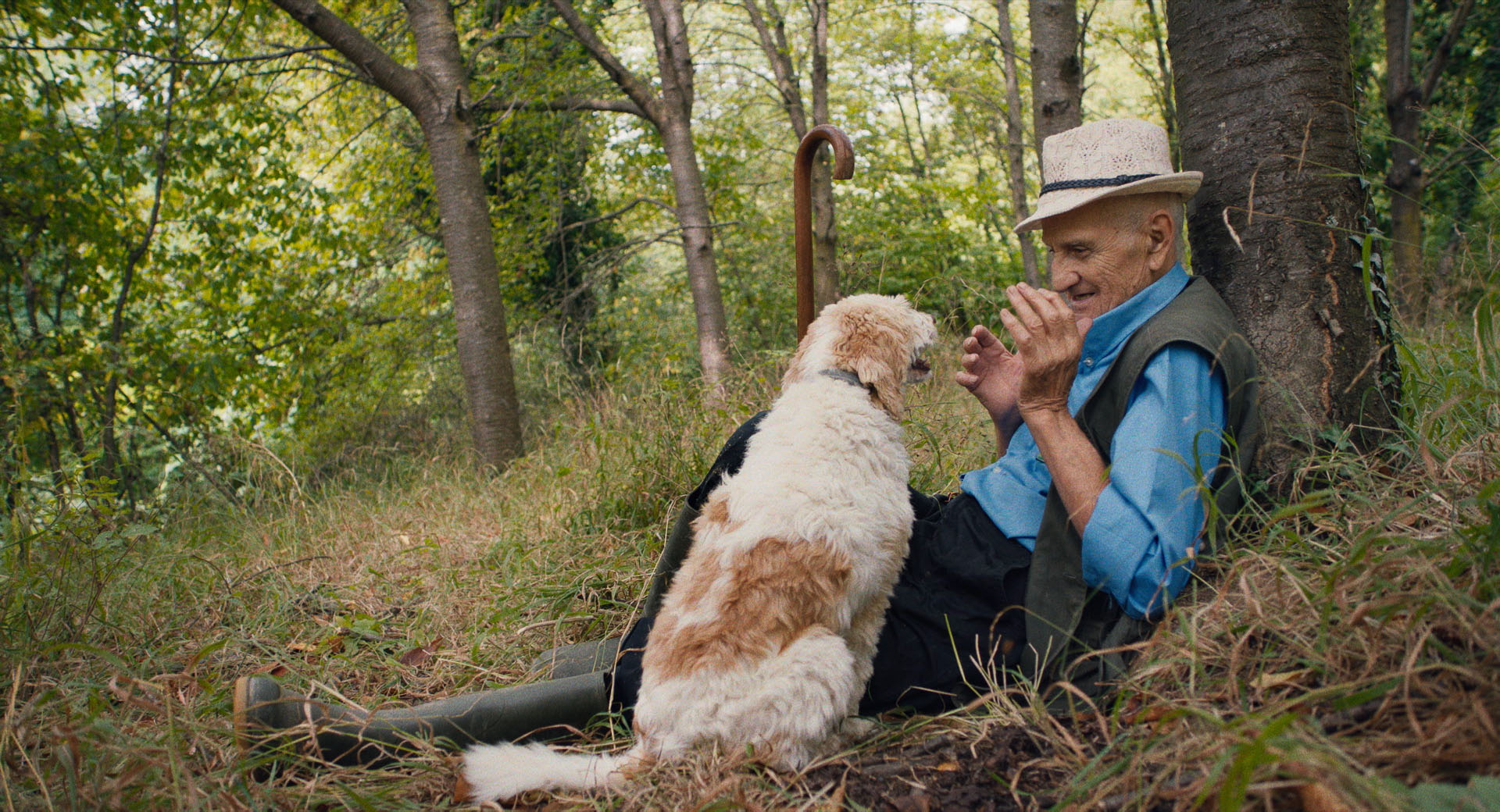
For one, fungi are one of my favorite foods in general, but yeah, truffles are just the best. I had some shoestring fries once which just had a sprinkling of shredded black truffles on them, and I swear I would be at that restaurant eating them all day now if I could afford it. So, yeah, there's a reason that truffles are so sought over by foodies and chefs the world over. They're also quite rare and hard to find, many varietals just can't be cultivated, so they have to be caught wild. That's the case, with the rarest of the rare, the Piedmont White Truffle, which can be found in the Piedmont region of Northern Italy, the area along the Southern French border. That's where we follow "The Truffle Hunters".
Who are these people who go out into the forest and have their dogs as they hunt and dig for the most expensive and rarest of truffles? Well, they're there old Italian guys, all of them about seventy or eighty years old. They head out to the forest and we see their dogs dig, sometimes from the dog's perspective. We hear them occasionally talk and pontificate on truffle hunting. We see them arguing with some of their buyers. Personally, I like the contrast between when we see a truffle pulled from the dirt and then placed on display on luscious pillows during the high-cost auctions.
The big appeal of the movie, for me is the cinematography. The movie looks amazing. The film's directed by the team of Michael Dweck & Gregory Kershaw, two directors with Cinematography backgrounds, and one of executive producers is Lance Acord, one of the most underrated cinematographers in Hollywood; he's worked with Sofia Coppola and Spike Jonze most notably. Honestly the life of the Hunters themselves didn't nearly intrigue as much as the gorgeous shots of the forests of Piedmont and the look of the film.
I'd probably like the movie more if it was a short subject, it does drag on and there's only so much you can say about truffles and truffle hunting. And if you haven't had truffles then I'm not sure how you can relate to this film at all. That said, I've had, so I get it, so I'll barely recommend it. Not as much as I recommend truffle fries, but I recommend it.
BILLIE (2020) Director: James Erskine
⭐⭐⭐⭐1/2
Telling Billie Holiday's story, has always seemed, to me, like a journey that's probably too harrowing and haunting to go down, as much as it is one that needs to be told. I of course, like everybody else have long adored Billie Holiday, and I often used her as a standard to judge other singers. I never fully appreciate Christina Aguilera as a kid, until I heard her do some jazz covers and if I closed my eyes when listening, well, she often reminded me a lot of Billie Holiday when she would do them. (Yes, sidenote: "Back to Basics", is my favorite Christina Aguilera album; I don't know if that's a controversial opinion or not, but yeah, I like her the most when she's being the most retro and jazz-inspired.) Still though, her life, telling her story, it's rough. It needs to be told though, and several people have tried over the years. And even then though....
James Erskine's documentary "Billie" is probably the best and most complete portrayal of Billie Holiday we have gotten so far, but it's not entirely appropriate to list him as the biographer, and he himself, doesn't. Erskine bought the rights to the collective material of one, Linda Kuehl. Kuehl was a freelance writer and arts journalist who spent the better part of a decade interviewing anybody and everybody who knew and was involved with Billie Holiday over the years in her attempt to write a biography on her. It never got published however, because she died unexpectedly in 1978, apparently from jumping out of her apartment window after attending a Count Basie concert, however her family have disputed this finding and don't believe the D.C. police ever went ahead with a real formal investigation. Her records have been used for biographries about Holiday before, but this is the first time most of us are actually hearing the tapes from her interviews. Much of "Billie" is about her struggles to piece together the biography and Erskine's attempts to use what footage and other interviews we have along with Kuehl's tapes to try to figure out what went wrong with both young women's sudden and sad ends.
Billie Holiday's life is beyond tragic. She was a prostitute at age 13, although apparently, she even had girls working under her, so she was also a pimp also. She was bisexual for most of her youth, usually bringing home women until she started her singing career. She was kicked out of Count Basie's band under some highly disputed circumstances, (Count Basie really does sound like a manipulative dick in his interviews) and had multiple husbands, one that was particularly abusive. She was a junkie, who even spent a year in jail in the middle of her fame, and was pursued by the U.S. Justice Department, mainly because she was a famous black singer who had influence over, but also because she was a junkie and hung around some other dubious characters. It's a tour through the time period as much as anything, but through Billie's eyes and through Linda's eyes on Billie.
"Billie" is a very compelling documentary. For those who love Billie Holiday, it's of course, more then satisfactory, but for everyone else, it's a harrowing look at Holiday herself, as well as a haunting entry into a past from the people who were there, and the young woman who collected all this history. We know the fate of Lady Day, swindled out of her earnings over the years, (although she apparently did spend quite a lot on herself as well) dying from heart and liver problems caused by years of abuse, but Linda's fate leaves a lot more questions then answers.
WRESTLE (2019) Directors: Susannah Herbert and Lauren Belfer
⭐⭐⭐⭐
(Sigh)
Okay, new rule, no matter how similar the subject matter might seem, no film should ever, ever, anymore compare itself to "Hoop Dreams". "Wrestle" isn't the first time I've seen this comparison either. "Wrestle" promotes itself on it's IMDB.com page as "'Hoop Dreams' goes to the mat"... and, just, just no, please stop. Like, on some level, it's always a bad idea to compare yourself to a better film, but especially "Hoop Dreams", arguably the greatest documentary of all-time! Seriously, like, stop doing that! Not on the promotional material for the film at least!
It's especially annoying because "Wrestle" is a pretty damn good documentary in its own right, but you know, everything's gonna seem average and mediocre in comparison...- All right, I'll stop on that front. The movie follows four high school wrestlers from the same school in Huntsville, Alabama. It's a new upstart program and the head coach is Chris Schribner, a young but intense civics teacher who's convinced he's got a team that can win at state, and potentially for some of the kids, a sports scholarship to a college, which is potentially a way out of the poverty and hopelessness they come from.
There's Jamario, the tender, dreadlock-wearing Senior who's girlfriend is pregnant and he seems to have little in terms of real support at home. Jailen is the quiet intense one on the team, a lightweight Junior who struggles to keep his weight down at first, but is the intense member of the team, seeming the most well-spoken and well-adjusted. Jaquan seems to be the most troubled, despite being a fairly conscientious young man, has some troubling friends and gets caught with marijuana one night. The cops by the way were pricks in this film, even as they seem to realize they're being filmed and think they're displaying the appropriate behavior. There's clearly something off with them.
Teague, the one white kid on the team, suffers through several debilitating personality issues. He's supposed to be on four different medications, although the only one he takes and seems to care about is marijuana. At one point, after he did something really stupid, the team confronted him pretty arduously for his actions, and it looked like things were gonna go down, but then they hugged him out.
The movie follows these young wrestlers and the coach for over a year of their lives, and the filmmakers Suzannah Herbert and Lauren Belfer spent the whole time living in Huntsville with them. They get very intimate moments between the team, the coach, their families..., by the end of the movie, I was genuinely curious to see what would happen to these kids, which I think should be the main goal of any of these kinds of youth sports documentaries. I remember the movie "Undefeated" won an Oscar controversially a few years ago, and that movie, I can only think about in terms of that Oscar, 'cause it's actually not particularly good at telling these stories and focusing on these lives. And this is a small subsection that could be a way out. Wrestling doesn't have the promise of the glamour of other college sports like football or basketball in America, and while there's definitely some skill and talent involved in competing in it, you really gotta both want it, and willing to put yourself and your body through a lot to even have a chance at getting any kind of recognition for it, and even then, it's a slim shot at recognition at best.
I wonder if there are documentaries like these in other countries? I can't think of any that have crossed over, even though there are young athletes across several disciplines all over the world; but I think mainly in America is education and athletics so intricately connected. "Wrestle" is another reminder of that and all the positives and negatives that entails for young, growing hormonal young people going through their own personal and competitive struggles just for a possibility of getting a chance to better oneself. I mean, even if they get to college, who knows how they'll respond there; I can't imagine Teague for instance doing particularly well there.
I guess they're using wrestling as a teacher in life as well. That's something the coach might be trying; he can seem to fall into surrogate parent figure for some of these kids a little too easily. That said, that's par for the job, and he does a pretty good job of it, even if he can be a bit militaristic and aggressive and clearly sometimes the kids are trying to blow him off.
"Wrestle" is no "Hoop Dreams", so yeah, in the future, don't put that film in my head; it makes any other film hard to talk about and compare; I cannot stress that enough, but on it's own, it's a better-then-average one of these films and should be watched and reviewed on it's own merits. It might not be a pinfall but it'll win your over on points.
Director: Mike
Nichols Screenplay:
Calder Willingham and Buck Henry based on the novel by Charles Webb
I feel like "The Graduate" is one of those movies that's gonna seem particularly out-of-step the further and further along we get into this post-"Me Too" future of ours. That's not a complaint or a criticism, just an observation. In fact, the downgrade and diminishment of "The Graduate" starting happening long before that. On AFI's 100 Greatest Movie Lists, "The Graduate fell from #7 on it's original list to number #17 ten years later. Honestly, I didn't particularly get why at the time. When I posted my Top 100 list, I had "The Graduate" in my Top 20 still. Would I have it there now...-?
(Deep breath)
Well, I was a lot younger then....
It's still such a huge part of the culture landscape, that I don't think it'll ever go away fully but it's definitely a movie that's about to finally not age particularly well. A lot of that is Dustin Hoffman's fault, who's basically been blackballed from Hollywood ever since he got called out for his antics, and his only known possible production that he's been linked to since, is a Broadway production of "Our Town" that may or may not happen with COVID now, but either way, let's face it, probably is not the best choice of production. It doesn't help that one of the movie's most well-known improvised scenes, involves him actually groping Anne Bancroft's breast. That scene, as great as it is within the context of the movie, plays a lot differently now that we've recalibrated what his motivations might've been. (It also doesn't help, when you realize just how much closer in age Hoffman and Bancroft actually were at the time.)
But perhaps, I was just young. The best time to watch this film is when you’re young. Like, a 21-year
old male fresh into college, trying to determine what to do with your life, young. I
know, the statement seems a little half-baked, but trust me, it’s totally
baked.
Whatever it's future status, unlike say "Gone with the Wind" who's cinematic accomplishments really aren't realized in modern cinema, arguably “The Graduate,” is the most influential American film post-“Citizen
Kane.” Editing techniques that seem fairly normal today came from this film. A
famous montage continually zeroes in on Benjamin Braddock (Hoffman in his first film role) face in one room
until it gets so close, then we continually back up to show him now in another
room, in another place in time. That was “The Graduate,” and that’s just one of
its inventions, like-wise the use of it's modern pop music as soundtrack, by using the
Simon & Garfunkel songs to underline the action.
The movie’s opening sequence finds Benjamin having forced to go to a party in his honor for his
achievements, with his friends,- well, really his father’s friends. Everyone has advice,
sometimes good advice about what he should do about the future, and he doesn’t
want to hear any of it. (Trust me, I know the feeling.) Using any excuse he can
to get out, he decides to take his Dad’s business partner’s wife home, the
notorious Mrs. Robinson. In reality Anne Bancroft was 36 and Dustin Hoffman was
30, but good lighting makes him seem younger and her older, and they have one of the funniest
sequences in a film filled with surprising and funny sequences after she, does indeed, seduce him.
After the affair has gone on for awhile, Benjamin, still
working hard to go aimlessly through life, decides to go on a date with her
daughter. Elaine (Katharine Ross) How he tries to sabotage this date, and then the events that
culminate in him crashing a wedding, and by the way, the most unbelievable and
most homaged wedding sequence ever, you have to experience to believe, and then
laugh. And then reflect, as they presumably do on, well, just, how ridiculous and stupid what they just did was. (Yeah, I don't think "The Sound of Silence" is anybody's wedding song, for a reason.)
I won’t reveal much more except to note that this movie is about that future unknown. Life has one plan while you may have another, as Mrs. Robinson reveals
in a sequence where she talked about once being an art major before having to
get married. Benjamin tries so hard not to fall into that trap, that he
eventually sets absolutely no goals for himself, leaving his ideas and actions
simultaneously endearing but lacking in thought. He manages to get away with
the daughter in the end, although he used all the wrong ways to do it, mainly
because he lacked the drive to do it thoughtfully.
In hindsight, Mrs. Robinson
is the film’s only interesting character. We are curious as to Mrs. Robinson
actions, and why she does what she does. But that’s because Benjamin has lived
so little life that he hasn’t experienced enough of it to be interesting. That’s
what inspires him through most of the second half of the film, not the love of
Mrs. Robinson’s daughter, but the need to have a life-altering experience. Too
bad he didn’t know about the LSD going around at the Berkeley Campus he goes
to. Many other late ‘60s staples are missing from the film where they should
be, because Benjamin is not even inspired enough to join the hippie crowd, or
maybe he just cut himself off from society so much, he honestly didn’t know about
it? He is a nothing in a time where everybody was doing something. The best idea he comes up with is to just float in his family's swimming pool.
I once observed that Hoffman goes through more doorways in the film then an Antonioni heroine. I kinda attributed that, mainly to Mike Nichols having inspiration from Antonioni, but I don't think I realized just how much inspiration he had, especially from films like "Blow-Up" or "L'Avventura", the former where a character seems completely at odds with the mod scene around him, and the latter, which is literally about a vacation, that continues on, even after one of the characters, just literally disappears. Usually when an Antonioni heroine goes through a doorway, it's an association with her, and usually a symbol that something is changes as she enters some place new, however a male character, especially if he's not the main characters, usually doesn't find such illumination. Is this a sly joke on Nichols part on just how little Benjamin actually evolves, going through doorway after doorway and not gaining any real new insight?
Maybe that's just how it feels now. 1967 is considered one of America's seminal film years, and Nichols won the Oscar for Best Directing for this film, an extreme rarity for a comedy, especially when the film didn't win any other Oscars, but it makes sense. The cliches of the college graduate unable to find his/her place in the modern world have basically all started from this film, and the styles of the filmmaking looks like nothing else that came before or since, even Nichols's first directing effort, the brilliant "Who's Afraid of Virginia Woolf?" basically just seems like a staged version of Edward Albee's play with a couple naughty words changed and an added location or two.
At the right time of life, "The Graduate" will always be a film that'll resonate as much now as it did upon it's original release, because
when you’re an early twenty something, the pressure to do something with your
life will make you think doing nothing is a great idea. I'm in my thirties and I still like the idea better
and better as I grow older. Perhaps that feeling of ennui will just never fully die off....
I write this Canon of Film post in the middle of the COVID-19 Pandemic in the United States and one of the things we're missing the most is sports. If you're not a sports fan yourself, I'm sure you know one and the majority of them are quite frustrated at this point. I'm in both those categories myself, and I can tell you that, it is tough. Most of the major leagues are trying to purportedly get things rolling again, in some sports cases to finish or start new seasons, and, honestly, I'm not holding my breath on this one; we're not getting sports the way we know it, for a long while. That's a real shame to, 'cause sports would both make a great distraction from, well, everything at the moment, but it also has an uncanny way of bringing together communities, cities, schools, even nations. Even under the worst of circumstances, it represents some of the best examples of, what is sometimes literal or figurative nationalism, in all the best ways. On top of that, there's a lot to like about sports. A lot of great drama, conflict, strategy, the amazing human performances, the pageantry, the spectacle, there's a lot of appeal to sports, and a lot of it is missing right now.
So, yeah, that's probably why I personally feel like a movie about a bunch of people not watching a sporting event would appeal to me right now, but of course, that context is much more my selfishness then anything to do with the film.
From my experience, I think the best foreign countries' films comes when they're movies are essentially relatively basic and simplistic in their approach to storytelling. Part of this admittedly is just, well the fact that I'm a dumb and ignorant American, so that automatically will just make it easier for me to follow, but with some of the Middle Eastern countries' cinema in particular, there's also a lot of power in those stories because, well, honestly, because of their "leaders," a lot of those countries have never gotten the memo to come to the 21st Century. Iran is one of those countries; the more universal the story is in an Iranian, usually, the better it is, and the more it often underlines some of the absurdities and troubles of the Islamic Republic.
Honestly, that's not terribly unusual for any country, once they go through their neorealist New Wave period, but Iranian New Wave, to put it lightly, is different then others and I'd argue nobody in the movement does it better then Jafar Panahi. There's a lot to talk about with him in particular, the big thing that most people know about him is that currently, he's banned from filmmaking. In 2010, he was sentenced to six years house imprisonment, after that, he's not able to leave the country of Iran except for celebrating certain religious rituals, and he's currently halfway into his 20-YEAR BAN from making movies. Yeah, don't think that's stopped him; he's actually managed to make five features and several short films since that banishment, that is still as of this writing, in effect. I've seen a couple of those films that he's made while in banishment, they're probably future entries into this Canon, but I can't say they're always the most entertaining; it's usually more the fact that they got made at all that's astonishing, expert filmmaking. Although, like most of his other films, they're obviously banned in Iran, although if he's managing to make movies like these under those circumstances, I'm sure many of the Irani citizens can managed to find ways to watch them.
I'd probably pick one of his other movies in another time to begin adding Iranian cinema to the Canon; I don't really know how high this one ranks among Panahi's films for most people. but it's been on my mind. (Plus, it's a DVD day, and since I can't go to the library right now, either, I've pulled from my own collection on this one, and it's the only film of his I've got a copy of.) The movie was shot mostly during a major World Cup qualification match between Iran and Bahrain in '06 at Azadi Stadium, a match that, with a win or tie, Iraq would qualify for the World Cup, and follows a group of women who tried to go to the game, but were caught, and the National Service men who have to keep an eye on them during the game, for fear that the Chief might come by. Women at that time, weren't allowed to enter the stadium for a sporting event.
That's basically it. There's a little square, "cell" that's flimsily put together with guard rails that aren't that hard to get out of. One of the girls, the one who's only described as "Soccer Girl" in the credits (Ayda Sadeqi) has to go to the bathroom at one point, and that's the most drama that occurs. There's no girls bathroom in the stadium, so her and the Soldier from Mashad (Mohammad Keir-Abadi), who they've been arguing about over a player that he's a fan of for most of the whole movie up 'til then, has to go through a fairly ridiculous process of putting a poster with eyes cut out on the girl's face, while he's closing the bathroom from the male customers, who keep coming in. He ends up losing her as she escapes in a melee, but she came back later, worried about the other soldier's (Safdar Samander) farm. If the soldiers lose one girl that's caught, they could be reprimanded pretty severely. The soldiers are conscripted, so they're more worried about not getting into trouble and getting forced into extra years of service, or worst.
They're already going to Vice Squad for their actions, which of course nobody actually cares about whether women are in the stadium. The girls keep asking why they're not allowed in, and the soldiers keep trying to explain why they're not allowed to go, but most of the Soldier's don't care either. They're aware that there's already a bunch of women in the crowd. We see the First Girl (Simra Mobarak-Shahi) in the beginning, trying and failing badly at blending in, and that's contrasted with others on a bus of fans who you'd have to look really hard to notice that they're women at all. She also gets confronted at one point by an older man, Shxyxn (Mohamad Asarian) who's looking for his own daughter who's her best friend. He doesnt' even recognize her without her chador on at first, but is angry that his daughter's somewhere in the stadium and can't find her, even though there's probably nothing to worry about, although he's annoyed that she lied about going to school to see the game.
(Shrugs)
Panahi, even before he got banned and put under house arrest, made movies about restrictions, particularly the restrictions of women in the country. In some ways, I think I prefer "Offside" to some of his other films because of how simple and inevitable it is. It's one of those weird movie ideas that feels like it's been around forever, even the title is just so naturally dead-on-the-nose you'd swear it must've been used before, and yet, it's shockingly modern. They have held women's sports events at that stadium in recent years, but currently the rule's still in place if there's "unrelated men" in the stadium with them. Yeah, I don't get it, and clearly Iran doesn't like self-criticism and yet, once the game ends, this restrictive country with outdated rules and ideas about men and women, starts to just celebrate joyously.
This films feels especially odd in a country like mine, where we're actually quite proud of our National Womens Soccer team, while at the same time they're fighting for equality, including equal pay with the perennially disappointment Mens' team, and yet, Soccer Girl is basically even more of a revolutionary when she talks about the fact that she plays in a local grassroots Womens league. Those do exist in Iran, btw, despite on a global stage the apparent lack of female athletes they seem to produce, but I can imagine that kind of talk alone shocking and annoying some over there.
It's actually kinda surreal to think about; in America, we celebrate our Women's team more then the Men, an extreme rarity in American team sports, while just the fact that women are playing at all, is like an achievement over there. It's not portrayed that way though, it's actually kinda subtlety brought up and nobody's particularly annoyed or frustrated by that revelation. The restrictions are just part of the daily life they have to traverse over there while otherwise, life goes on. It's a revolutionary grand protest in abstraction, but it's a legal annoyance in practice.
At the end of the movie, they're boarded a bus to Vice Squad to be arraigned, and they're listening to Iran win on the radio, and the country suddenly turns into a riotous celebration. Only two people aren't outwardly celebrating, one of them is the Azerbaijani soldier, who just cares about getting back to his farm, and the other strangely is the First Girl we followed. She actually starts crying afterwards, and it's here where we learn that she wasn't a futbol fan.
Her best friend was though. On March 25, 2005. the year before "Offside", a World Cup qualifying match between Iran and Japan at Azadi Stadium ended in tragedy after there was a horrific crush after the game when purportedly, people tried to exit the stadium through an unauthorized exit. In the melee and riots, six people were killed and over 40 were injured. Her friend was among the dead and she was going to the game in honor and memory of him.
Like I said, sports is so ubiquitous that even non-sports fan can get caught up in the accomplishments of, your team, when they do well.
The movie ends with literal fireworks and the bus getting caught up by the celebration in the streets. "Offside" manages to get this, in a perfect matter-of-fact simple way, it criticizes the country and then its simultaneously celebrating the people of the nation. Those who live with the restrictions put upon them and yet still happy and proud of themselves. You rarely see anybody worried about themselves in the film, even the one Soldier Girl (Mahnaz Zabihi) who's in more trouble then the rest because she disguised herself as an officer to get into the game. She's somewhat worried, but even that fear fades.
I fear I'm making this movie feel somber and like a heavy-handed lesson on the heartships of places that aren't where we're at, but the movie much funnier and full of wit then I'm letting on. Even with every other conversation underlining how absurd the situation they're it, it's a punch of sports fans talking about sports while a game is going on. They share in the drama of the moment and the camraderie of the shared experience. You don't see too many movies about sports fan in general, and usually if you do, it's either about how unhealthy it is, or the fan learns that there's something more important then sports, and being in the film world I usually find most fans should belong in one of those, but this one, it's about everything good about being a fan. Appreciation the team, appreciation the country they and often you yourself represent, and appreciating each other.
I don't really have much to note this week. The Emmy nominations took up quite a bit more time then I planned. Lots of TV to catch up on, and yet, the Olympics are finally here. Personally, while I know logically these are a general bad idea during this pandemic, I'm still excited for them. I'm a sports guy in general, but I like the idea of the world coming together for the greatness of human physicality, and then laud it over them for nationalistic pride when we win.
If we win, this year. There's a Simone Biles or two here who I know are gonna dominate, but this does feel like a relatively weaker U.S. year overall. We really should be better at some of these sports, like how did we not even qualify for Men 3x3 Basketball?! Christ.
Anyway, as to movies, an interesting batch this time, but not a huge eye-catching batch. Among other things I'm finally hoping to get to my Best and Worst of 2019 soon, but in the meantime, let's get to this batch of reviews.
THE HALT (aka ANG HUPA) (2021) Director: Ang Hupa
⭐⭐⭐⭐
I believe at some point, everybody who's ever watched a Lav Diaz film will have the same reaction. They'll have a big dreary-eyed yawn, they'll pause the DVD or stream and say something, "Oh christ, how is there still two friggin' hours left in this damn film!" That's not a criticism of the film by the way, no bad movie is too short, no good movie is too long, movie lengths are as much based on selling more tickets at screenings then anything else. Still, Diaz, his movies are long. I don't know why he loves movies these lengths; at almost five hours, this is not only one of his shorter movies relatively shorter, it's actually probably his most commercial of his films, most of which usually make the uber-indy festival rounds before eventually finding worldwide cult acclaim. He is considered one of the very best directors the nation has produced, and probably the nation's current most acclaim modern filmmaker.
The last film of his I saw from 2013, "Norte, the End of History". which was a modern-day take on "Crime and Punishment". I enjoyed it a lot, but I didn't take a lot from it. I don't know how much I'm gonna take from "The Halt" either, but that's more of a criticism of me then the film. I'm a little familiar with the history of The Philippines as a country, but his movies definitely reveal my lacking in a lot of the minute details of modern life, or in this case, futuristic life, since techincally this is a sci-fi film, although it's probably more dark satire then anything.
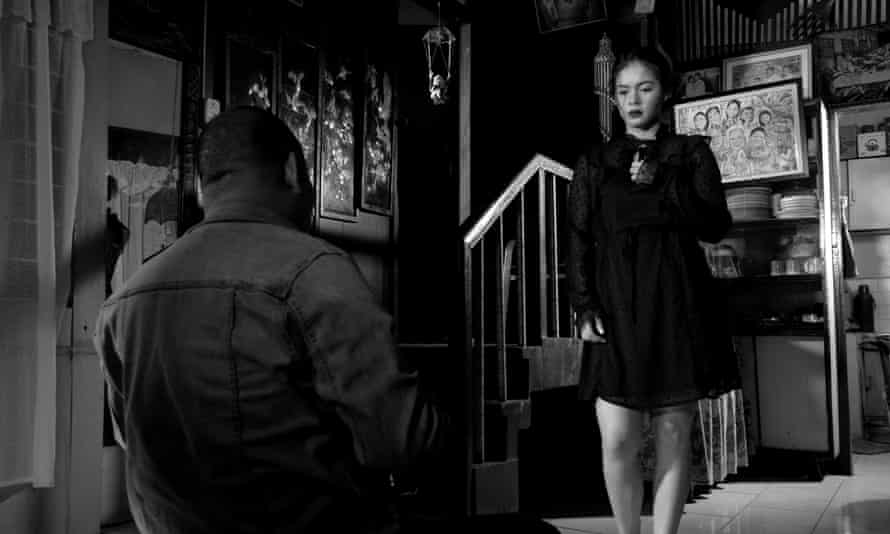
It's the year 2034 and in this future, volcano eruptions have plunged most of Southeast Asia into permanent literal darkness. It's been that way for a few years now, and now there's also a worldwide flu pandemic that's also quietly destroying the people. Also being that way, is that the nation is run by a dictatorial madman, in this case, President Navarra (Joel Lamangan). Now, this is a scenario I do know a little about. The country is infamous having two different genocidal dictators, Ferdinand Marcos who ran the country for over twenty years, and their current benevolent ruler, President Rodrigo Duterte. It is pretty easy to see that Navarra is a parody of one or both of these men and probably dictatorships in general. There's scenes of him giving orders, interviews with foreign journalists, I like one sequence where he's going over the speech he'll give later and they argue over whether certain words are English colloquialisms worth saying. Sometimes he feeds his dissidents to his pet alligators.
That's one of the strange things with Diaz, while his movies are long, they're actually not terribly plot heavy normally; they're way more slow and forceful, and minimalist. The director I think of with him the most is Bela Tarr, who also has long movies with long minimalist long takes that you don't know where exactly they'll go or to what extent until the end, if that. Diaz is nowhere near as oblique and symbolic-heavy, but he gets his points across.
The characters we probably focus the most on are two female soldiers of Navarra, Marisa (Mara Lopez) and Martha (Hazel Orencio). We often see them debating and arguing between themselves on Navarra's orders as their grip on his true touched-by-God status begins to fade. Marisa in particular seems far more complicated, especially when she seemingly goes into these strange seizure-like twitches and dances almost randomly, which are often match-cut later with her, mid coitus and orgasm with Haminilda (Shaina Magdayao). Hamilinda's a prostitute that she sees on a regular basis, who spends her downtime speaking with a Dr. Hadoro, who she uses like a psychiatrist to help with her personal repressed memories. There's a lot of symbolism in that story is not only is their repression about the horrors of the past and present, but in the Philippines, sex worker is generally one of the more notoriously unsafe professions out there. (You can watch the documentary "Call Me Ganda" if you want a little more info on that)
There's also a former soldier named Hook (Piolo Pasqual) who was one of Navarra's most loyal soldiers but has become a freedom fighter and both of them are trying to take the other out.
There's also a lot of violence in the movie, usually in sudden shootouts and violence by the police. I could barely follow it all; I've been told they are related to other stories, but I didn't think they had to be. They fit pretty well into this creation of a sci-fi fascist future that Diaz clearly fears we're heading towards. He's old enough to have lived through one and is clearly warning of another. Duterte is most noted for his genocidal "Drug War" that he's raised on his citizens. People are missing and found killed pretty regularly there because of him.
The movie eventually ends, on a hopeful note, albeit a sardonic one. I've seen multiple reviewers compare the film to Jean-Luc Godard's "Alphaville" which is also a political sci-fi allegory that's more about the world the stories in the film take place in then what actually happens. That's probably a decent comparison, although, obviously it's a lot shorter and Diaz is much more absurdist in his approach to the wit in the film. These stories do interconnect, but they're more their to show the several different incestuous sides to the kind of incompetent corruption that makes up these kinda of fascist regimes. The movie debuted in 2019 in its home country in 2019, so a year ahead of our own pandemic-infused world of darkness took over that we're only now, maybe, starting to climb out of and back into the light, assuming the incompetent don't change the game to take over again. (Fingers crossed) It's probably the perfect timing among everything else for a hypnotic languid dive into Diaz's work like this, and the movie does seem more opportune now then it probably ever would've for me.
Again, the intricacies of The Philippines socio-political landscape still leave a part of the movie allusive for me, but what I could catch and grab onto, I admired greatly. Diaz isn't for everyone, but for those who are willing to engage, there's a lot of insightfulness there.
STRAY (2021) Director: Elizabeth Lo
⭐⭐⭐1/2
Alright, new Netflix film in the mail.
(Opens Netflix envelope)
What's this one called? "Stray"? Hmm, what's this about?
(Reads Netflix disc jacket)
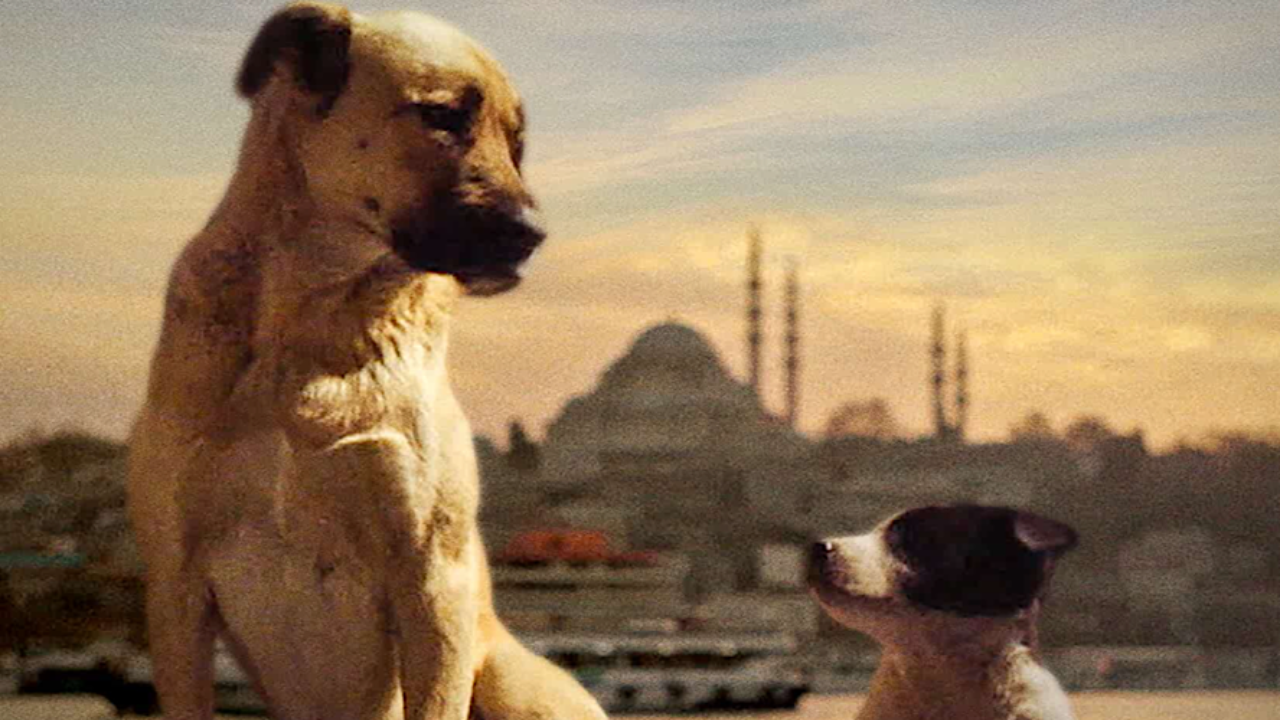
"With the camera following three stray dogs--- Zeytin, Nazar and Kertal -- this touching documentary provides a canine's eye view of Istanbul...-Wait, what?
Istanbul!?!? ISTANBUL!!!!!!
(Continues reading)
...Istanbul and it's inhabitants as the pooches roam the city streets night and day! NO!
NOPE!!!! NOPE!!!!! NOOOOOOOOOOOOOOOO!
(Whiny)
Na-OHHHHHHHHHHHHHHH!!!!! Not that again!?
(Sigh)
I guess I should explain. If you're wondering about my severe reaction to what otherwise seems like a relatively benign documentary about dogs, well, this movie sounds incredibly similar and familiar to a film called "Kedi", a movie that I listed as the worst film of 2017. This was a movie that literally just followed street cats around Istanbul, and it was trash. It's a literal 75-minute Youtube cat video. I found it torturous, and felt that it made every argument the Spielbergs and Scorseses make about how movies need to be seen on large screens and in movie theaters and whatnot seem 100% legitimate. I'm one of the few people who went hard on that documentary, and yes, just looking at the sleeve jacket, this movie felt and looked little more then basically, the same movie, but with Istanbul dogs. Is this just another 75-minute animal video from Youtube?
Ummm, actually, no it wasn't. For one, it's a different group of filmmakers, led by director Elizabeth Lo. For another, it's shot better and makes more interesting observations and ponderings. There's three stray dogs we spend time with throughout the documentary. Admittedly, part of me wonders why the filmmakers didn't just pick up the dogs and take them home to adopt them, but then again, how often do we do that with animals we find off the street. (Technically, we really shouldn't be doing that anyway, it's hard for street animals to evolved and adapt to a new homelife, but whatever.) Still, though, especially after we follow a couple dogs through a great handheld shot down the streets and into dark alleys were we see them meeting up with people who seems to like them, but these homeless-ish people then just let a couple of the dogs start battling each other. It's not a dogfight per se, that's like set up or anything, but as somebody who actually did once witness two dogs just, suddenly and with little-to-no preparation suddenly start attacking each other, it's a horrific scene in real life, and a stunning one in the film.
The movie does feel low to the ground most of the time, like a stray. They hang around trash cans and walk through the crowded city, the sound mixing is excellent as we often overhear random spurts of half-conversations, that occasionally may or may not be about the dogs, but we don't always know the full context and certainly the dogs probably just recognize them as random voices of the city they peruse and live with.
And there's a lot going on in the city. Istanbul's homeless population are often Syrain refugees we come across and some of them are the ones that start taking in these homeless dogs. (Fine, maybe I do owe "Wendy & Lucy" a rewatch) There's also just the fact that there is such a vast population. There had been regular sweeps for strays in Turkey, but it's illegal to kill or euthanize or hold captive any stray. They do have some rights and they do have interesting experiences with humans. Some are good, some are more disturbing. I don't know how neorealist the film is; it's certainly more neorealist then the distressingly awful "Kedi", but I certainly more about the dogs in "Stray" and the humans interacting with them, both in front of and behind the camera.
Lo is a much more interesting documentarian as well. She's American-educated but Hong Kong born, and she takes a more observant look at these dogs and make greater points about life in Turkey which is still in peril in many circumstances. The movie in many feels like an old cityscape movie, only with the dogs, and with this case, sound, since most of those movies predate that in movies. "Stray" is the movie that "Kedi" could've been. I did say that I probably could've tolerated that film more if it was something more then a prolonged Youtube video, and yes, there's ways to tell the story of stray animals in the city correctly and "Stray" proves that. It's a compelling meditation that takes us not only into a world and place we rarely see, but from a perspective that we rarely get and it does surprisingly well.
THE LIFE AHEAD (2020) Director: Edoardo Ponti
⭐⭐⭐
Sophia Loren was my grandfather's favorite actress. He loved her, and he met her once when she had a meet-and-greet at some mall once upon a time, and he mentioned that he was saddened by the encounter. I think he was expecting this legendary larger-then-life Italian goddess that he'd seen on the screen, but instead, she looked fairly normal. I can see that, makeup and lighting can do a lot, and that's not to say Sophia Loren isn't a beauty or anything, she most definitely is, but yeah, expectations and all. That said, I've also heard stories that in public, she'll often disguise her appearance when she doesn't want to be recognized. I heard one story from a local cab driver one time, that she disguised herself so well that she got angry when the cabby didn't recognize her.
I tell you these anecdotes I have 'cause honestly, I actually haven't watched a great deal of Sophia Loren over the years. I've seen more then I actually thought, looking through her filmography, but except for "Two Women", which won her her Oscar, most of the movies I've seen her in are her more recent albeit sporadic mainstream works, like "Nine", "Grumpier Old Men" and "Ready-to-Wear [Pret-a-Porter]"; that last one I didn't even realize she was in. (I oughta rewatch that one, that was an underrated Robert Altman.) She's slowed down, but she's never outright stopped acting, entering her seventh decade of filmmaking, and is as fierce and passionate as ever.
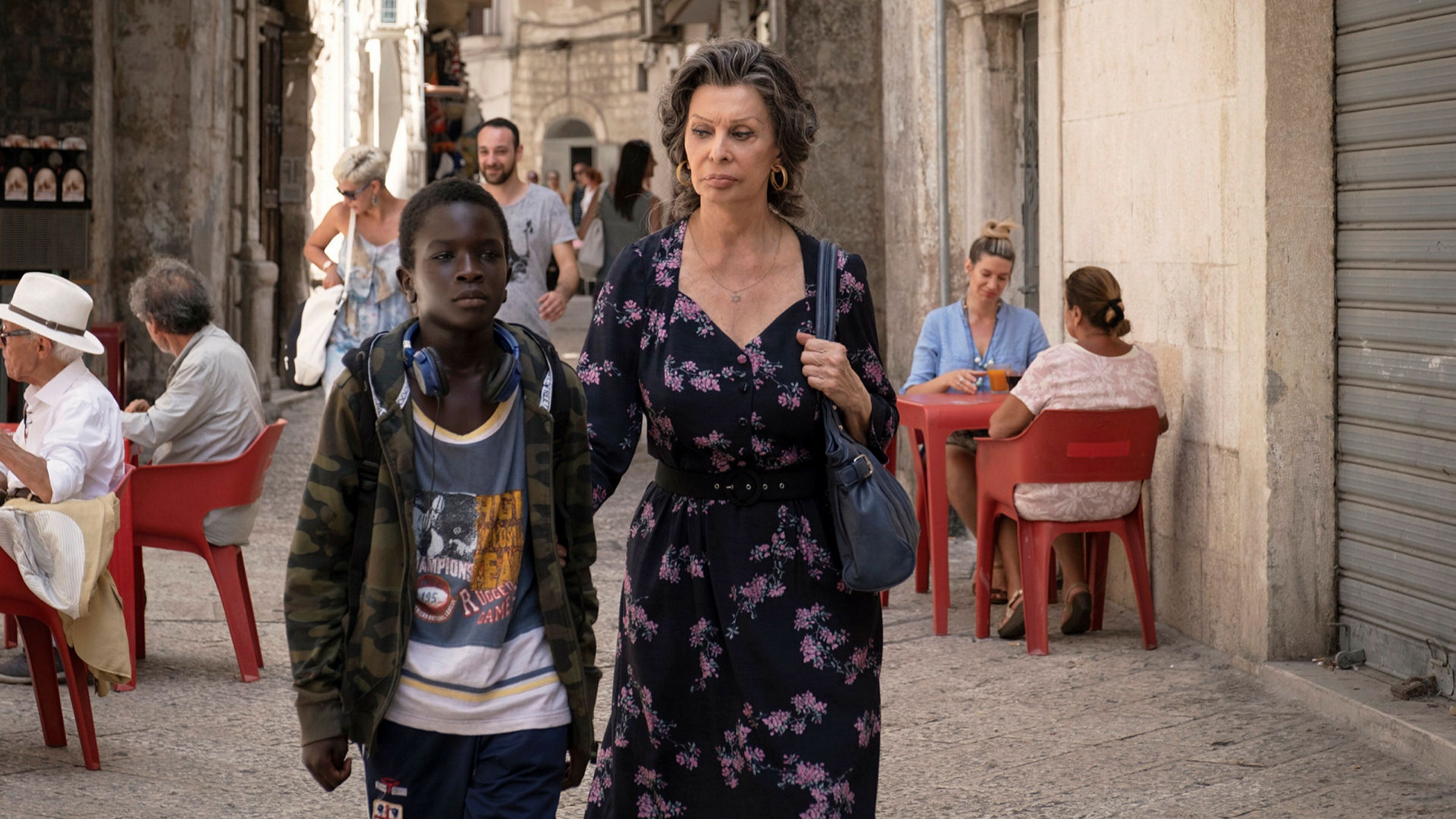
If this is her final performance, and I don't in any way hope it is, she's leaving on a good one. Directed by her son Edouard Ponti, "The Life Ahead" is an adaptation of a French novel, "The Life Before Us", one that was already adapted successfully to film once before as "Madame Rosa"; that adaptation won a Foreign Language Oscar. This version, Loren plays Madame Rosa, an octogenarian who's kinda of a neighborhood matriarch. She's had a helluva life, one that gets slowly revealed during the film. The movie is mainly focused on Momo (Ibrahima Gueye) a young Senagalese street youth, who's taken in by Madame Rosa, after robbing her. It's not the most deep story, it's basically just a tale of a kid who grew up without any guidance finally finding a parental figure he can look up to, but it's told well.
Momo is the kid of a prostitute and her pimp, and after they're gone off, he's hustled on the street of Bari, Italy, currently he sells drugs to get by, something that Rosa disapproves of, but realizes that there's little to be done about it. Rosa is a former holocaust survivor who herself was a prostitute too, but not has grown to running a daycare essentially for the kids of other wayward women. She's getting older now and as she starts to lose some of her faculties, those old repressed memories of hiding from the Nazis have started to come back to her.
She gets help from Lola (Abril Zamora) a trans prostitute who seems to be too intimating for anyone to deal with. She's one of the most delightful parts of the film as her presence just is a delight to this film. Meanwhile, Rosa's sudden outbreaks of dementia seem to mirror Momo's occasional outbreaks of anger, which can occur almost at anytime, often when dealing with Hamil (Babak Karimi) who instigated him being Rosa's ward. It's actually quite fascinating how much care there is from the adults in this film, who seem to have lived with watching struggling kids like Momo their whole life, and seem to know exactly how this'll play out if they say the wrong things.
I think the real appeal of this story is how much you enjoy the life surrounding the characters, whether it's appealing or not. One movie this reminded of strangely was "Harold & Maude", which is weird 'cause I genuinely can't frickin' stand that film even though it's supposedly so uplifting and effervescent, perhaps it's because Harold is somebody who just seems so shallow to begin with..., but I digress, I like the relationship here better. It's not a perfect film, I don't love the voiceover from Momo for instance, but I enjoy the world and these characters. It's a complex relationship between two people who've been through a lot and keep their emotions at bay until they come out in outbursts living on the fringes of society. Sometimes that, and some good casting is enough. The movie's well made and well-acted, and of course it's a showcase for Sophia Loren and she nails it.
HIS HOUSE (2020) Director: Remi Weekes
⭐⭐⭐
You know, something that just occurred to me with haunted house movies, is that, it's never the main character's actual home that's haunted. Figuratively speaking, not necessarily literally, but even still, I can't think of any film where the main characters are haunted by the house or other building which they would otherwise they would firmly consider their home. They're always haunted in someone else's place, usually the home's owner(s) is whatever's haunting or scaring them, essentially as a staking of a claim. I'm not against this, I've even written this trope before, but it is kinda odd in retrospect how hauntings are so intertwined with, well, no pun intended, possession. It's always presumed that the place that's haunted is haunting for a reason, and the most likely reason usually has to do with a claim of ownership of some kind. It's never just haunted us, to haunt us. I'm not sure which would be more frightening to me, but yeah, I'm kinda surprised that it's up 'til now that we get a haunted house film called "His House" until now.
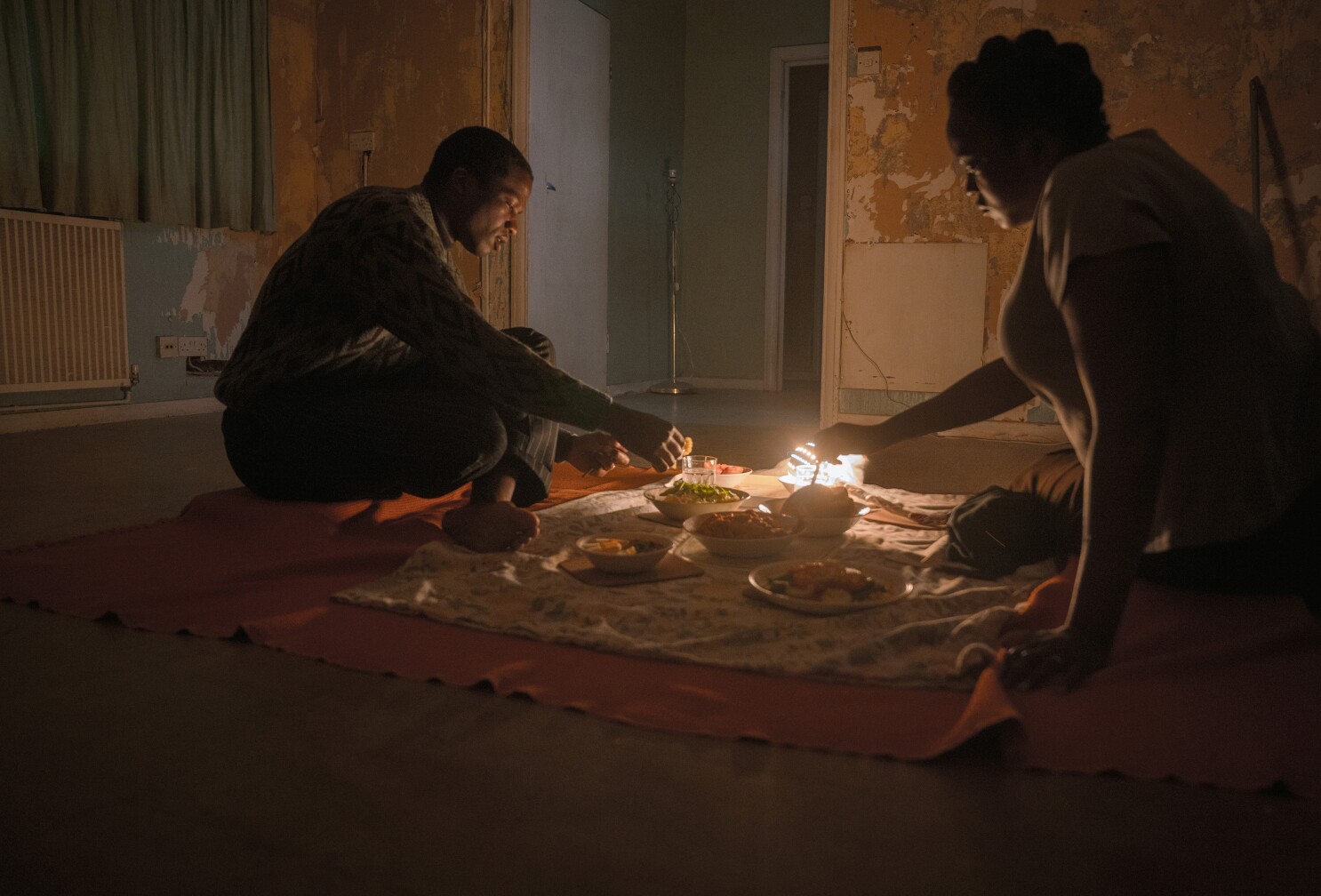
The film is fairly unique for a haunted house movie. It's not a house that's got the typical trappings of some place that most ghosts who, despite the hypothetical ability to travel anywhere they want, would want to stay and hang out, we get a fairly innocuous little place, the new temporary home for Bol and Rial (Sope Dirisu and Wunmi Mosaka). They're South Sudanese refugees/immigrants, who made the long escape from their wartorn country, eventually making it to London, despite losing their daughter Nyagak (Malaika Wakoli-Abigada) where they're given a small chance to make a life. A slightly better one then most we're told by their caseworker Mark (Matt Smith), as most immigrants usually get shoved together in group homes with multiple families, but still, not the ideal house for ghosts, but these ghosts followed them here.
I'm not sure how much this is specifically about the conflict in The Sudan specifically, or just a parable for the struggles and often horrors of refugees from any war-riddled country, but the ghosts that haunt them take the form of something they called an "Apeth", a mystical creature in South Sudanese folklore who's apparently followed Bol and Rial all the way up to their decrepit London abode. I'm looked into what the Apeth is, it's basically equivalent to a night witch, but it's a little more complicated then that, and it involves actions from the characters that don't get revealed 'til later in the movie, so I won't go into them here. I think it basically represents all matters of horrors that one must leave behind, and the true inability to ever have them completely leave oneself, especially for those who come from such horrors, and the decisions that they themselves had to make in order to make it to where they are now.
That's something in particular that I hate about people who seem to have absolute disgust for any kind of immigrants, especially refugees. There are scenes of racism that the couple experience, both literal and systemic, including one disturbing scene where a few British teens of African descent, tells Rial to go back to Africa after she struggles with the English language. She personally doesn't even want to stay actively refusing any kind of assimilation, which Bol actively tries for. They both have shared demons from home, and they share this Apeth that's followed them along and deems to take them for their sins.
Honestly, I don't know quite what to make of "His House" overall. I watched the film twice, the second time through I appreciated it more, but I can't say I was blown away by it. The movie had become a cult hit, especially in its native UK where the movie did well at both the BiFas, their equivalent of the Spirit Awards, and at the BAFTAs. It's an interesting debut feature from Remi Weekes, but perhaps the language of literal horror movies wasn't the perfect genre for this story. I can think of many good and even great films about immigrants struggles with dealing with their war-torn past as they attempt to build and create a new future for them. The big example in my mind is "Sophie's Choice", and while everybody remembers the one flashback scene from that film, in actuality there's a lot of wonderful and fun cultural exchanging stuff in that film, and the appeal of the movie is how delightful Sophie is, despite the true hardships she had to live with. I'm not saying that "His House" should've taken that route, 'cause there are some problems with the narrative of "Sophie's Choice", but I think the story leaned too heavily on horror movie ideas, as opposed to the genuinely more interesting horrors of war and struggles to start a new life aspects. Despite everything, I think the movie didn't really portray the regret and guilt that these characters have, or at least not convey it in the fullest way they could. Honestly like, falling back on the horror movie parable of this ghost-figure, while accurate to South Sudanese mythology, feels a bit like a cop out to not actually go into the more intricate stuff in greater detail.
I've always hated mixing real-life horror with the fantasy tropes of horror, especially the ones in horror movies is a really difficult tightrope to walk, and one that I genuinely don't think works since it either cheapens the real life events, or it trivializes the movie tropes.
I'm still gonna recommend this movie, 'cause there's good ideas here, talent behind and in front of the camera, and obviously some important and essential looks at the everchanging world and the collateral changes that cross both literal and mental boundaries, but I was overall underwhelmed by the film. For a film that's barely eighty minutes, I feel like it was trying to put too much in here, and Weekes didn't necessarily trust his material enough to extend and take some time on some stuff the way he probably could've. There's nothing here that I think he should've absolutely taken out, but maybe he could've dwelled and taken more time on these characters, not just because it would help us get invested in the conflict they have with the spirit, but also I kinda just want to know about them more then I did. It's a mixed review, but I suspect Weekes has better and more compelling stories within him, and I'll be waiting for when he really gets them told as well as he can.
SORRY WE MISSED YOU (2020) Director: Ken Loach
⭐⭐⭐⭐1/2
I don't know what the term for it is in the UK, but in America the term, "Independent Contractor" or some official variant of it, comes up a lot. To some extent, it's a natural progression of what's been termed the current "Gig Economy", but in other situations, it's an employment status that sounds more promising then it actually is. It's sold on the false notion that you'll get to be your own boss, while still clearly working at the behest of someone who seems to be able to just exploit labor more then most. It's basically modern-day sharecropping, only instead of working on a farm, they're delivering packages to everybody, and it's basically creating a world of Jobs. Well, jobs too, but I meant Job, as in the Biblical Job. (Pun unintended)
This is not surprising as a subject matter for Ken Loach, the legendary British neorealist director. He made a film a couple years ago that I didn't get to see in time for a review called "I, Daniel Blake", a powerful strike back to his neorealist roots that showed the struggles of a guy trying to get his pension after having a heart attack. Had I gotten to the film sooner, I would've put it on my Best of the Year list, and it was one of Loach's best films in general. I kinda caught onto Loach late, and usually with his more mainstream movies like "The Wind That Shakes the Barley" and "The Angels' Share" good movies, but they never particularly appealed to me. I still have to get to a lot of his earlier works like "Kes" or even some more acclaimed recent stuff like "Looking for Eric" and "Sweet Sixteen". Still though, going back to this more stripped down, more non-actors and more down-to-Earth simple tales of the downfall of the lower and middle class is probably where he's at his strongest. With England still reeling from the effects of Thatcherism, and in this case, the '08 Stock Market crash,
It's in this setting that we meet and follow Ricky (Kris Hitchen) a longtime worker who lost his job right as he and his wife Abbie (Debbie Honeywood) were about to pay off a house. She works as a home caretaker for the disabled and elderly, Ricky, after years of odds of hardworking jobs, gets a delivery truck, working supposedly as his own boss, which basically means that, you work for me, and the me in this case is Maloney (Ross Brewster) the personification of human exploitation. He runs the local branch of PDF, a not-so-subtle reference to that one company that delivers stuff that you're thinking of. He works fourteen hours a day, six days a week, and he has to sell the family car to afford everything he needs, which is what his wife drove from work to work with.
It's hard to describe all the details of what happens next, it's basically what you'd expect, as the roughness of the job exhausts him, and eventually his family. He battles everything we expect, everything from annoying customers to struggling to stay awake on the road to even getting attacked and beaten up. Meanwhile, his family really struggles. Their teenage son Seb (Rhys Stone) really begins to act out, and the more Ricky seems to work, the more Seb acts out, always more and more disgusted with his father who is barely there. His ennui is frustrating both Seb's mother and his little sister Liza Jae (Katie Proctor), and as he acts out, his father begins to act out as well, disturbing the family even more, and he doesn't quite have the capability to self-analyze and reassess himself and his priorities, and I can't blame him. Financial struggles often take precedent and financial struggles and work struggles breed the situation for the cracking of the family unit. At the end, the family is begging him to not go to work, but he has to go to work. It's very "Young Goodman Brown" to be honest, fees are just piled up and eventually you're either in indentured servitude without a family or in debt without a home.
"Sorry We Missed You" is purportedly a loose sequel to "I, Daniel Blake", I wouldn't be surprised if these movies are apart of a trilogy of some kind or anything, they definitely feel like they exist in the same universe, but you don't have to see one to see the other. (Although I highly recommend both) Perhaps this film is a little weaker then "I, Daniel Blake," but only because it's more frustratingly predictable. Daniel Blake was a man with nothing to lose so his rebellion at the end felt righteous, but we don't get any of that here; we get a family caught in the same circle of poverty. "Sorry We Missed You" is a brutal mirror to our society, but it's an essential and important one that needed to be made and absolutely needs to be seen.
BEANPOLE (2020) Director: Kantemir Balagov
⭐⭐⭐⭐
(Deep sighing breaths, eventually followed by a several tongue-sucking under-breath utterances.)
Tsk....
(Deep breath)
Before I even begin this review, um..., well, this movie "Beanpole" includes a disturbing scene in it, that, I'm just gonna be blunt here, I saw it, I had to stop the film, 'cause I couldn't deal with it. I'm gonna describe it in a bit in my review, 'cause it's an early scene that's too plot relevant not to reveal, and also, I don't think it's something that I should not tell potential audiences about, but it disturbed the hell out of me. Normally, I'm much more blasé in terms of what others might find disturbing in a film, I might mention something shocking and unexpected like this but more dryly and unemotionally in tone then others, and just explain the events without without getting into the emotional details, but in this case, I'm going to make a huge exception.
In fact, I seriously thought about, just, not even finishing this movie, something that I take pride in almost never doing, but-eh, this movie got me thinking about it. It was that disturbing to me, so consider this your TRIGGER WARNING, 'cause this movie triggered me, so....
(Deep breath)
With that out of the way, "Beanpole" was the Russian Federation's submission for the International Feature Film category last year, and it's a tough one to get through. Loosely inspired by the works of Svetlana Alexievich, the film is a look at Post-WWII Russia Soviet Union, and the struggles of those who fought through the war coming home. Not, necessarily the soldiers though; in fact this is one of the few coming home from war movies that are about female participants in the war, and by far the earliest movie in terms of when the war occurred. That's a big plus right there.
That said, this story is brutal. The main characters are Iya (Viktoria Miroshnichenko), a skinny tall nurse who's nicknamed Beanpole, and suffers from a traumatic post-concussion PTSD condition where her whole body will suddenly freeze up and her friend Masha (Vasilisa Perelygina) who wasn't so much on the battle grounds on the warfront, but was very much apart of it and that left her with permanent scars. As well as a young kid, which, while she was out of town and Iya was watching, she accidentally smothers to death when she has a paralysis episode. (This is the scene I'm warning everyone about; if you can't with it, I don't blame you for not watching the film, or subsequently, just, fast forwarding through this part.) Masha is, shockingly understanding about this, and is still tentative friends with Iya; it's only afterwards when we find out exactly what her position in the war was does it make sense, and that's a long way's out. It doesn't get completely revealed until after she starts dating Sasha (Igor Shirokov) a wealthy son of a local official. They have some complicated, but playful interactions, and soon, seem to fall in love.
Masha, among her several physical and emotional scars from the war, has had a hysterectomy, and Iya, owing her a child, ends up wanting to have a kid for Masha. This leads to, among other things, the most uncomfortable and disturbing, well, I guess technically it's a threesome sex scene that I've ever seen. I get it though, remember this was long before the time where surrogacy was much more common and the now-traditional scientific and medical techniques for such a thing weren't developed yet, but it's still a really bizarre scene, and it's not even with Sasha, it's with a doctor, Nikolay (Andrey Bykov).
The whole movie has this dour depressing state swamping over it, like the Vermeer-esque look of the dull lifelike browns and greens envelopes the film, almost until we actually see the Sasha's parents (Denix Kozinets and Kseniya Kutepova) more Romanoff-like house at the end when he tries to impress them with Masha.
The movie's more episodic in nature then I'm explaining here. For instance, there's a whole subplot at the hospital Iya, and eventually Masha, work at involving a quadriplegic patient named Stepan (Konstantin Balakirev) a soldier who's wife (Alyona Kuchkova) has already told their family and kids that he died during the war. The mixup alone is horrific, but Stepan tells Iya to euthanize him, as he's not sure what use he'd be to either his wife or himself alive now. There's some other side plots as well. I'm making the movie seem inherently depressing, which it is, but it's also a movie about surviving and moving on with your life after war, despite the fact that those horrors of the war still linger on, whether it be permanent, in the mind, body, or even in the guts of those who were apart of it. It takes a lot out of you, and even with rebuilding, the war will still effect your lives.
I'm kinda amazed that director Kantemir Balagov is so young; he's not even in his thirties and this is only his third feature, but I would've guessed this was a veteran filmmaker deep into his career. He's very purposeful in his shots, using a lot of long unbroken takes that can be very uncomfortable but there's a method to it. I suspect he's seen a lot of Tarkovsky being Russian. I'm definitely interested in his earlier films from "Beanpole", although I'm admittedly still hesitant on it as a whole. Definitely recommending it, but know what you're getting into. This is an uncomfortable film about several uncomfortable subjects but it is a story that deserves to be told.
END OF THE CENTURY (2019) Director: Lucio Castro
⭐⭐1/2
I read a few reviews of "End of the Century" that mentioned the film, "Sliding Doors" a few times. "Sliding Doors" is one of those weird movies that does get mentioned and parodied often, and, I-eh, I don't really get why. Honestly, that's a very forgettable, and kinda boring movie. I know it's premise is kinda noteworthy, but I feel like there should be better examples. Like, literally, I don't think anybody remembers anything else about that movie, and why would they? It's a film I struggle to remember actually exists.
Besides, it really doesn't apply here. "End of the Century" isn't a rom-com about two scenarios playing out depending on whether something happened or not. It does have an interesting premise in of itself. The debut feature from Argentinean director Lucio Castro is about two people, Ocho (Juan Barberini) a poet who's currently on vacation in Barcelona, and Javi (Ramon Pujol) a local TV director. They have a meet cute, and then hook up in Ocho's hotel room. It's only after that they realize that they've met up before. Twenty years earlier in fact.
Yeah, that's when the movie does jump back in time, and to me this was a little confusing. Like, when they both first met up in their early twenties, they were both still straight and they're a little unsure of themselves or their sexuality. We do see them meeting in the past and they have a very tender little one night stand over A Flock of Seagulls's "Spaceage Love Song".
I guess the presumption is that the movie is about time itself, and how it can kinda exists beyond temporal limits, like how twenty years later these two characters still have a spark, and I guess they wonder about what could've happened... This is kinda where the movie loses me. I like the idea of two people meeting when they were young, not going through with a relationship, forgetting about each other, and then reuniting by accident twenty years later, when both characters have made choices and priorities with their life and they have to consider and re-evaluate the possibilities of their future and their past, I just don't get the idea of this being inherently related to time. I guess that's why everybody's trying to put this in the "Sliding Doors" milieu but I think it's more relatable to Andrew Haigh's "Weekend" or even Richard Linklater's "Before Sunset". There's a glimpse of the idea of the one that got away, or that one girl Mr. Bernstein from "Citizen Kane" famously regrets not talking to in his youth, but distinctly remembers in his old age, and looking back on it, but I don't know. The movie feels like it's trying to be more cerebral then it is.
I think it's at its best when it's just focusing on the fact that these two people, whenever they meet, have great chemistry and attraction to each other, and that should just be the thing. I don't think the movie actually has as much to say about time as it thinks it has, but I like the idea of the romance. Eh, I don't know, part of me wants to recommend it, but it did make me feel cold after everything. Eh, I think I gave my generous extra 1/2 star to "His House" this week. Yeah, the movie's interesting and I want to know what the director does next, but it's a little thin. Too thin. In between everything else, the movie makes up for it's lack of much else narratively by becoming a mini Barcelona travelogue, and that's kinda where I think it fails again. I mean, I guess I don't mind the idea of "Ocho Javi Barcelona" either, but yeah, this movie, needed to be more intimate, like "Room in Rome" perhaps. Interesting idea, but the movie is a missed connection for me.
Maybe I'll like it better in twenty years.
TOP END WEDDING (2019) Director: Wayne Blair
⭐⭐⭐
There are certain countries in the film world that seem to be more natural fits for road movies then others. The United States, is a big road movie country, with a couple decades of great examples from "It Happened One Night" to "Sideways". Brazil is another one known for them, some great movies like "Central Station" or even "Pixote: The Law of the Weakest". Another country that's known for them is Australia. In fact a lot of Australian media can seem like a road story. It is certainly this strangest of countries, a continent-sized island with a giant desert in the middle of it that's so vast, it's always a bit of a shock to us foreigners, (Or at least us American foreigners) that there are actual towns and cities outside of the nation's southeast coast.
Darwin for instance, one of the country's major ports, it's the capital of the Northwest territory, and a key trading outpost for the country in it's connection to Asia. As well as, some of the even more obscure places in the country, ones that I even had to look up. I'm usually pretty good at this geography thing, but this one I had to look up, just north of Darwin, on the other side of the Clarence Strait are the Tiwi Islands. The main two in the archipelago are Melville and Bathurst, and these are the ancestral home of the Tiwi people, one of the Aboriginal tribes of the nation.
Lauren, (Miranda Tapsell) is a Sydney-based associate lawyer working for one of those cartoonishly over-the-top female bosses, Ms. Hampton (Kerry Fox, doing a decent version of Meryl Streep in "The Devil Wears Prada".). After she finally gets the associate gig, her boyfriend Ned (Gwilym Lee) a prosecuting attorney who suddenly quits his job and immediately proposes to Lauren. They decide to get married quickly and they head up north to her hometown of Darwin and get married in this rare ten-day window her boss has granted her. She even comes up eventually to help plan the wedding.
However, when she goes to her parents' house, her father Trevor (Huw Higginson) is in a permanent depressed state, often heading to the pantry to lock himself in and play Chicago's "If You Leave Me Now". This is where the road movie aspect actually comes in, even though they've already gone from Sydney to Darwin, but that was by air. Lauren's mother Daffy (Ursula Yovich) has left her father, and as she and her husband go a wild chase trying to find her as she is determined that she needs her to be there for the wedding, although that changes as the search continues, and that includes whether the marriage should even go on....
Honestly, this is fairly predictable rom-com fare. The best thing really about it is the setting, as Lauren and her mother's journey, eventually leads them back to her island home and to their culture. Lauren was born and raised in Darwin and her mother, who had a falling out with her family when she married Ned, a white man, hadn't gone back home in decades and Lauren was so far enough removed from this aspect of her heritage that she never fully connected to it.... So, the movie is essentially a getting back to your roots journey. I wish there was more then that; the movie barely gives us a real sense of the Tiwi culture and people, which I guess is on purpose, but still... "Top End Wedding" is the newest feature from Wayne Blair, the Australian TV director most known for "The Sapphires" in the feature film world, which was an interesting if flawed music biopic that has one of my absolute worst and laziest factual inaccuracies I've ever written in a review, where I complain that they sang a song that hadn't been out yet in the period the film took place, when in reality they did.... Stupid me, I didn't know Salt-N-Pepa's "Whatta Man" was a sample from Linda Lyndell's "What a Man".... I don't know why I was confident enough in that fact to bring that up, but-eh, yeah, I gotta apologize to Blair for that, if nothing else. Bad review of mine, wish I could take that one back.
That said, "Top End Wedding" is a better film, but it's not a special film. I like that Blair is trying to tell some stories about the Aboriginal peoples of the country, and this isn't a terrible film or anything; I'm gonna recommend it, barely, but I fear that he basically only can tell these tales through the most conventional and episodic bad television tropes style. Still, I'm glad someone's trying and you know, if the only thing different with this film is the location and the insight into the lost cultural identity of the Tiwi People, then at least it's an interesting location and the Tiwi are people who I honestly never knew about before. Might as well learn something from a very traditional romantic wedding comedy as anything else.
ANTHROPOCENE: THE HUMAN EPOCH (2019) Directors: Jennifer Baichwal, Edward Burtynski and Nicholas de Pencier
1/2⭐
(Sigh)
I wasn't gonna review this movie for this post, I'm actually behind posting this and I have others things I want to get to, but, I had this on while I was working on other things.... and now I gotta talk about it. Now unlike "Stray", this documentary's description didn't make me start involuntarily twitching. On Kanopy, the film is describe as:
"A stunning sensory experience and cinematic meditation on humanity massive reengineering of the planet... A years-in-the-making feature, the film follows the research of an international body of scientists, the Anthropocene Working Group who, after nearly 10 years of research argue that the Holocene Epoch gave way to the ANTHROPOCENE EPOCH in the mid-twentieth Century as a result of profound and lasting human changes to the Earth. From concrete seawalls in China that now cover 60% of the mainland coast, to the biggest terrestrial machines ever built in Germany, to psychedelic potash mines in Russia's Ural Mountains, to metal festivals in the closed city of Norlisk, to the devasted Great Barrier Reef in Australia and marrive marble quarries in Carrara, the filmmakers have traversed the globe using state of the art camera techniques to document the evidence and experience of human planetary domination."
Okay, there's a lot of words that do indicate for most that this is simply a film to skip, "Cinematic meditation" "Sensory Experience", and whatever-the-hell words like "Anthropocene" and "Epoch" mean, but there's some interesting-sounding stuff here too. Sounds like a deep dive into the modern history of humanity, and you know, I can deal with that. Even the meditation stuff; one of my favorite films in recent years is Ron Fricke's "Samsara" and that movie is basically just a meditation on ourselves. There's a way to do this. This could be artistically compelling as well as educational, right?
Then, I looked at the filmmakers. The movie's credited to three directors, but the main one is also the film's writer Jennifer Baichwal, and I'm sorry, I'm not vibing with this girl at all. Now, outside of this film, she seems to be a somewhat normal documentarian. She co-directed a doc on the rock band, The Tragically Hip, she made a doc that was inspired by a Margaret Atwood novel, some other biodocs here and there, but mostly when I run into her, she's doing this..., I guess technically they're environmental docs, but she's trying to go deeper on some kind of metaphysical level with them, and she does that by using, some admittedly stirring and amazingly modern cinematography, but my god,- maybe some people are getting to that point with her, but I'm sorry, she just totally fails with me every time. This is the second film of hers I've seen, and believe it or not, this movie might be a little better then that one, maybe.... (Shrugs) [Maybe not]
The last one I saw was "Watermark", which made my Worst Films List the year it came out. That movie used a lot of helicopter and drone shots to outline how the changing of the water levels has effected the planet, like, how some rivers use to run and now they're just dry sand with, well, watermarks from where the water used to be. I'm not apathetic towards the subject matter; I live near Vegas and the sea levels at Lake Mead and Hoover Dam are getting disturbingly lower and lower since I've been alive and you can see just how much on the sides of the hills and mountains, but the movie didn't really do much else. It tried a few times, but I'd either fall asleep from these nine-minute tours over the Grand Canyon or wherever the hell we were, or the talking heads were just too dull and not interesting in between.
And "Anthropocene..." is kinda the same, only a little more elaborate, as it's subject matter is even more grander as it talks about the Earth as a whole. "ANTHROPOCENE: The Human Epoch" (I've seen the title "Anthropocene" capitalized in some places in the "official title" and not capitalized in others.) is about the recent human effects we've had on the Earth. Anthropocene is a geological term for the current geological age where human activity has the most dominance. "Epoch" is also a geological term for a period of time, but it's a reference to a person's life, and focuses in on the important events that shape a person. So, I think the movie's attempting to show humanity's distinctive events that have place us in this current time period and show the distinctive events that represent humans' physical effects on the Earth.
So, we see stuff like the Corals dying out and the excessive pollution in the Urals, and all this stuff, is boring, but at least is interesting and on-point, but then there's some weird asides that are, kinda tertiarily related. Like there's a musical performance of some kind during one of these trips they've made to the corners of the globe and that seems to get way more time then I probably would've given it.
There's narration by Alicia Vikander that occasionally interrupts those long takes with intriguing facts to go with the images, but both of them kinda fail me personally. I guess the point of the movie is that all these events and occurrences, the building of concrete stoppages from the ocean, the ivory trade that's led to the elephant endangerment as well as preservation forces in Africa, to etc. etc. that they're all apart of this current transitioning geological era... but I just didn't care.
I mean, part of me's wondering why I should care? They don't make that clear, like is all this stuff inherently bad, or are you just documenting the changes for preservation. I kinda had that issue a bit with "Watermark" too; I feel like I'm supposed to be learning or caring for something, but instead I'm just perplexed by everything and I feel like I'm watching a very environmentally-conscious annoying friend's vacation videos. Like Jessie Spano at her most intolerable and pretentious. They even talk about how there's been five previous extinction events in the world's history, that we know of, and that maybe true, and hopefully we're not plunging headlong into another one, but honestly, it kinda makes me wonder why should I be worried about this one? I'm as liberal and environmental-savvy as I can be, and even I'm trying not to sound like one of those right-wing nutjubs who thinks we shouldn't get COVID vaccines because it'll all work out in the end and the pandemic is just the earth thinning out the overpopulation herd, and it's not like I'm personally looking for something to disagree with the film on, but I feel like I'm just trying to grab onto something, anything at all. I feel like I'm just trying to feel anything from these movies and I just feel numbed and not even a defeated numb, just a bored and tired numb, the kinda we're just exhausted because you're doing more work then the movie is.
"ANTHROPOCENE..." probably has ambition I can admire, but I find myself just bored and baffled by it. If this filmmaker can bore and frustrate me, a guy who loves to find out stuff and wants to learn about the world and all their troubles and issues and loves informative documentaries on such subjects, then this movie must be unbelievable torture to anybody who isn't looking for any of this. It's not even meditative, which, first of all you should probably either teach us or be a meditation, it's really hard to do both, in a documentary no less, but also, her ideas of meditation just seem to be long beautiful shots of wherever she is. This isn't even good for meditative documentaries; I'd rather watch other docs I hate like this, like 2012's "Leviathan" about North Atlantic fisherman or even "Russian Ark", that movie that was infamously all one shot travelogue through a museum that also was a guidebook through Russian history. I'm the only one who actually does find that movie boring and the gimmick tedious in that film, but boy, I might re-evaluate it after being reminded of how bad these films can be. I hate to be this mean, especially since I think Baichwal must be more interesting on some of her other work, but if these are the kinds of productions she really cares about making, then, I don't know what else to say, but I don't think she's good at making them.