I plan to post a lot more Canon of Film entries in the immediate future of this post. "Plan to", obviously being the keyword, but also "post" because I do have a lot more to get around to. For those who maybe are new to this blog, even before I ever started writing her, I had written several of what would become the Canon of Film and one of the reasons I actually started posting was that I was writing a bunch of these and believed I needed an outlet to post some of them, as well as other movie reviews and other commentaries on the entertainment world that, I otherwise struggled to find elsewhere on the blogosphere, as it was once called. I don't know how many blogs are even out there anymore, but my thinking was that, when I was devoting most of my time to more modern material writings, I'd have things to post ready prepared to basically cut-and-paste with only a few modifications, just so I could continually put out work. Well, at some point, I didn't write here nearly as often as I was back then, and now I don't even really intend to, I just post and write here when I feel like it, but more importantly, when I hadn't posted in a prolongued period of time, I still would go through and post a Canon of Film, but eventually, I got older and wiser and started to sort through a lot of those older writings, and realized that I didn't particularly like most of what I wrote back then. Some of them were so underwritten that if I was gonna post them, it'd basically be the equivalent of completely rewriting them from the ground up; a lot of these were just, minor blurbs that were intended as reasons why certain films needed/should be watched, and frankly I was younger, and the younger you are the worst a writer you are, and yada, yada, yada.... Eventually I just didn't post these older ones as often and if I did, there was a lot more re-edits and rewriting to them. I'm not saying they're terrible or not worth reading anymore, but more often than not, when I do dive into earlier stuff I've written here, I find myself cringing at a lot of what I wrote and felt was worth posting when I was younger. Not the content of my opinions per se, but definitely the quality of the writing. (And occasionally I've gotten an opinion wrong too, but still, if they were written better.) I end making more edits to my old work on here than I do writing newer material, and it's annoying to have to go through that sometimes. Hell, I'll probably do it to this post soon enough.
Anyway, recently I was looking through my old writings and decided to look at what films that I have prewritten that I haven't posted yet, thinking it would only be a few, maybe five or ten posts.... It's more like 50! Which is annoying, 'cause what I really want to do and planned-, well, still planned on doing, is writing a bunch of new Canon of Film posts. I'll still write these movie reviews of course, but I want to cut down on my commentaries. For one thing, I'm also writing a lot more screenplays and on other projects right now, so those commentaries are planning to be fewer and farther between, unless something really intrigues me enough to write about it, but yeah, mostly what I want to do these days is watch great old movies and write about them, and both of those activities are harder to do than they used to for me. And yeah, looking back and realizing that I actually have a lot more left to do on this blog from when I originally intended,- that, that gave me pause.
So, in the future, I'm gonna post more Canon of Film posts between these review posts. Sometimes it'll be a newer one, sometimes it'll be one I wrote on years ago, decades ago now, but will almost definitely be rewriting and reworking from my old scribbles, but- best laid plans, and usually best to start planning after you finish your original laid plans.
Also I want to promote Geekcast Radio Network's recently released "100 Greatest Animated Series 15th Anniversary Countdown"! They polled quite a few people, including myself to create their Top 100 List, and they just released numbers 25-1 just now. If you want to find out what shows ended up where, the links to their podcasts are below, and it's worth listening to, and I was happy to participate. I've participated in a few of their older polls; I released my ballot on this yet, I can't remember if I posted my ballot on the blog's FB page or not, if I didn't I'll post it later, but check out the podcasts for the full results.
GEEKCAST RADIO 100-76
GEEKCAST RADIO 100-76
Anyway, that's all the housekeeping for now. Let's get to these latest movie reviews!
THE MIRANDALORIAN AND GROGU (2026) Director: Jon Favreau
⭐⭐⭐1/2
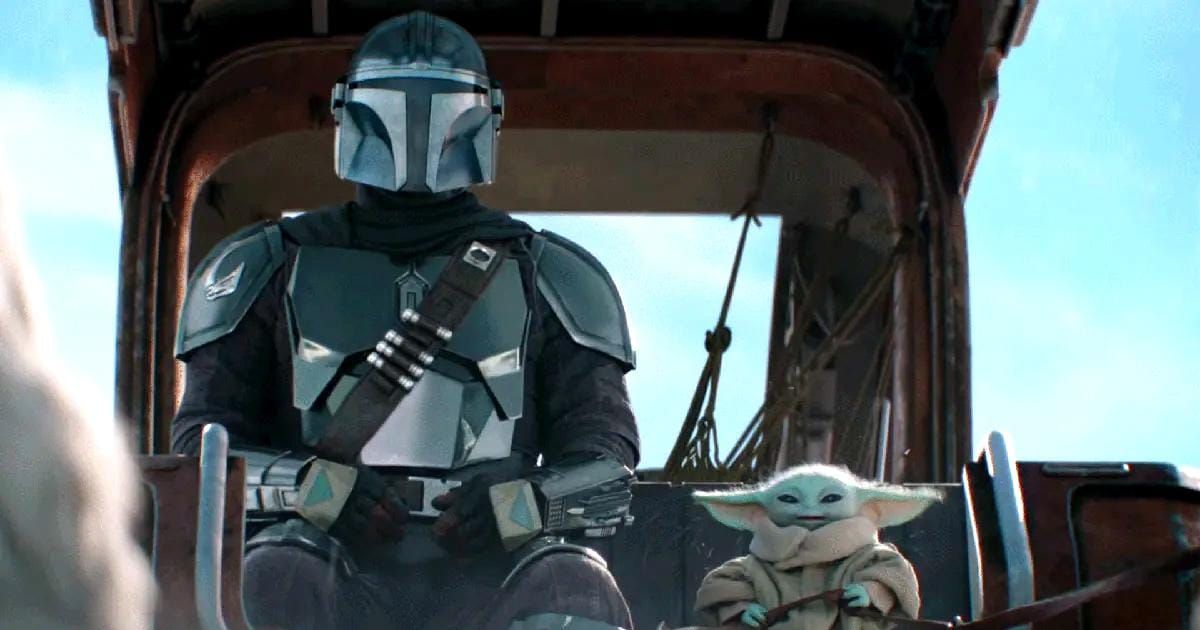
(Shrugs)
Unless I'm forgetting something, and I don't think I am, I believe this is the first time I've seen a "Star Wars" movie, in a movie theater. That's the kind of statement that I suspect might surprise a lot of you, but-eh, for one thing, I've never really been a "Star Wars" fan. I don't hate "Star Wars" necessarily, I've certainly been far less annoyed by it than many other overexposed Hollywood franchises I can name, but I haven't or have rarely, if ever, really chosen to go out of my way to see any film in the series. I didn't go see any of the re-releases of the original when that happened when I was in middle school; apparently I might've been the only one who didn't see any of the prequel movies in theaters-, in fact, I still haven't seen, whatever the third one of those were, eh, (Imdb search....) "Revenge of the Sith". I only started watching the others when I was an adult, and other than thinking that "Attack of the Clones" is the first genuinely bad "Star Wars" film, (Bad and boring, honestly; that was a chore to get through) I don't hold that many strong feelings towards the first two. I liked the original movies when I saw them, and I guess I'd argue "The Empire Strikes Back" is a great film, but I never found them films that I would normally go out of my way for. I certainly never actively kept up with the majority of any of the outside the main narrative stories through books or television series,-, well, most of them I haven't kept up with. I did see the first season and I think a little of the second of "The Mandalorian" and honestly reason I watched that is because of the Emmy nominations it was getting and hearing that it was good. I didn't watch it 'cause it was "Star Wars", and frankly while I liked the show, the less I thought about it as "Star Wars" the more I enjoyed it. To me, that show was much more of a western that happened to take place in the "Star Wars" universe.
Which I think is my issue with the franchise, in that, I just think the worldbuilding of "Star Wars", is,-, it's actually not that interesting. In fact, it's really thin. For all these frickin' talks about the Empire and the Rebel alliance, and how everything is a grand fight for control, there's actually really little discussion of like, actual politics of the world. Honestly, I'm just baffled by how much keeps getting added to the franchise, more movies, more TV series, more animated series,- and honestly, the only thing we genuinely know, is that one side is good and one side is evil. How is this universe so friggin' elaborate and expanding? Like, I'm not a fan of these cinematic universes, in general, and usually my complaint is that there's just way too much and it's too elaborate and the science doesn't work in the world, 'cause the worldbuilding is flawed,.... stuff like that, but "Star Wars", it's like, the exact opposite issue-, it's not bad worldbuilding necessarily, it's just so light and flimsy, that I'm kinda amazing people finds anything deeper in it at all. It's so underwritten, and that was fine for the early films, 'cause their inspirations were Saturday morning matinee serials, like the Buck Rogers kind of stories, but it's been fifty years, and for something that's supposedly so beloved and elaborate, it's just never progressed further than that.
Hell, I think that's part of why I did enjoy "The Mandalorian" the most when it didn't feel like "Star Wars", 'cause it didn't feel like "Star Wars", it felt like one of those classic old westerns, like "3:10 to Yuma" or "Unforgiven", one of those films with a lone stranger who's on a long journey to deliver something, usually, and in this case, awwww, a Baby Yoda! Ot-eh, Grogu?! Baby Gro-gu?
(Sigh)
I only watched one season of "The Mirandalorian", maybe a little of season two; I went to this movie with a friend who wanted to see it. I liked what I saw, but I don't really know the show all that well. (Although I did a spit take when Werner Herzog appeared in the series; that's about the last person I expected to see in "Star Wars" anything.) Apparently, he's not Yoda, but he does have powers similar to Yoda, he's Grogu. And after traveling around with him for a few seasons, The Mandalorian (Pedro Pascal, along with-, this is interesting, there's top credited Stunt Performers for The Mandalorian [Lateef Crowder], as well as a "Suit Performer" [Brendan Wayne], hmm,- I'm wondering if this is kinda like that time those three teenagers won the Best Actor Tony for playing the lead in "Billy Elliot"?) eventually adopted him, 'cause even though Grogu's in his mid-fifties, he's still a toddler, 'cause Yoda's species do that, and he also becomes his mentor, so we have a father/son dynamic, along with a mentor/mentee dynamic. He's pretty damn helpful Grogu, even though he hasn't fully grasped the entirety of his powers yet, and he still doesn't know how to start a spaceship.
Basically a lot of this movie is just a scene, and then cutting to Grogu doing something, and going from big actions sequences to aww, how cute! Again, not really a complaint, the one "Star Wars" aspect I did like about the series, is little Grogu. Which begs the question, since this isn't Yoda, but we all want a Baby Yoda so badly, well, why or why have we not gotten a "Baby Star Wars" series!? Like, that I would watch. I mean, think about, Baby Han Solo, Baby Princess Leia, Baby Luke Skywalker, Baby Yoda, Baby Chewy, Baby Darth Vader, Baby C-3PO and Baby R2D2, spending their days playing together and getting in their own adventures, before Nana takes them and puts them down to bed; it'd be amazing! I say, if we don't get a Baby Star Wars series, and get one soon, we should riot! I mean, c'mon Disney, it's right there!
(You think I'm joking, but seriously, "Baby Star Wars", would be a-maz-ing!)
Anyway, the movie, "The Mirandalorian and Grogu", it's-, it's fine. I enjoyed it. It's a little long, had a few too many endings. I suspect if you liked the series that you would like the movie. There's a few other strange cameos, while The Mandalorian is an independent contractor, he's working closely with the Rebels, and his boss, Col. Ward (Sigourney Weaver) constantly complains about how all his assignments end up "messy", and rarely does he get the job completed, exactly how it's planned out. Like, he's supposed to play off the Hutt Twins, who've taken over the Hutt criminal empire, have been working with the Rebels, and will trade info on a secret hidden Empire leader, named Coin, in exchange for finding Rotta (Jeremy Allan White) their nephew and rightful son/heir to Jabba the Hut and bring him back. Rotta turns out to be on another planet, where he's enslaved by a fight promoter, Lord Janu (Jonny Coyne) and has become quite the cult hero for being unbeatable. It's basically the plot of that one episode of "Star Trek: Voyager" where The Rock guest starred and he had to take on Seven of Nine. It gets more complicated from there obviously, and there's some good classic Star Wars shenanigans from there.
(Sigh)
I never know what to say about films like these anymore, especially with "Star Wars" which, even a good side project, and "The Mirandalorian" is a good one, feels so far removed from the franchise main or proper that I don't really know how to elevaluate it. I have a similar hard time with any of these uber-franchises and these way, way, way, too elaborate cinematic universes and "Star Wars" always feels like too simple a world to begin with, so these stories don't make it more elaborate or complex to me; they feel like I'm learning about a story that happened to somebody's distant relative's best friend's in-law who I don't know to begin with.
That said, it's a good enough story and it clearly mattered to somebody. The film was directed by Jon Favreau who co-created the original series, and-eh, I just-, I just don't know what to make of him anymore. He's an interesting filmmaker to be sure, but he's been so caught up in the monolith that is the Disney conglomerate for so long now, that I feel like if anything actually comes out of him that does represent him as an artist, it's almost by accident anymore. That's not necessarily true mind you; he's done these kinds of films for so long that I have to presume it is something that inspires him to make these big budget blockbusters but it doesn't always feel that way though, especially with his last few feature films. Outside of the delightfully little small movie "Chef" he's made the unwatchable "Cowboys and Aliens" and then two of the most dreadful and useless of the Disney "live-action" reboots "The Jungle Book" and "The Lion King". But, he seems like he's inspired by "The Mandalorian" and you can feel that here. I don't know if this is the greatest story; I think one of the strengths of the series was how it can make these kinds of picaroesque narratives seem more thrilling and intriguing, even within a Lucas universe; it almost feels disheartening to put this show onto the big screen, but-, you know what, if the series itself has run it's course and the next story is just something for a couple hours, than I'm find with it.
Admittedly that's mainly just because I want to see more of Grogu. He is delightful in this thing. Sometimes a cute little baby puppet is really all I need to be entertained.
Seriously, "Star Wars Babies" somebody should get on it!
WICKED (2024) Director: Jon M. Chu
⭐⭐⭐
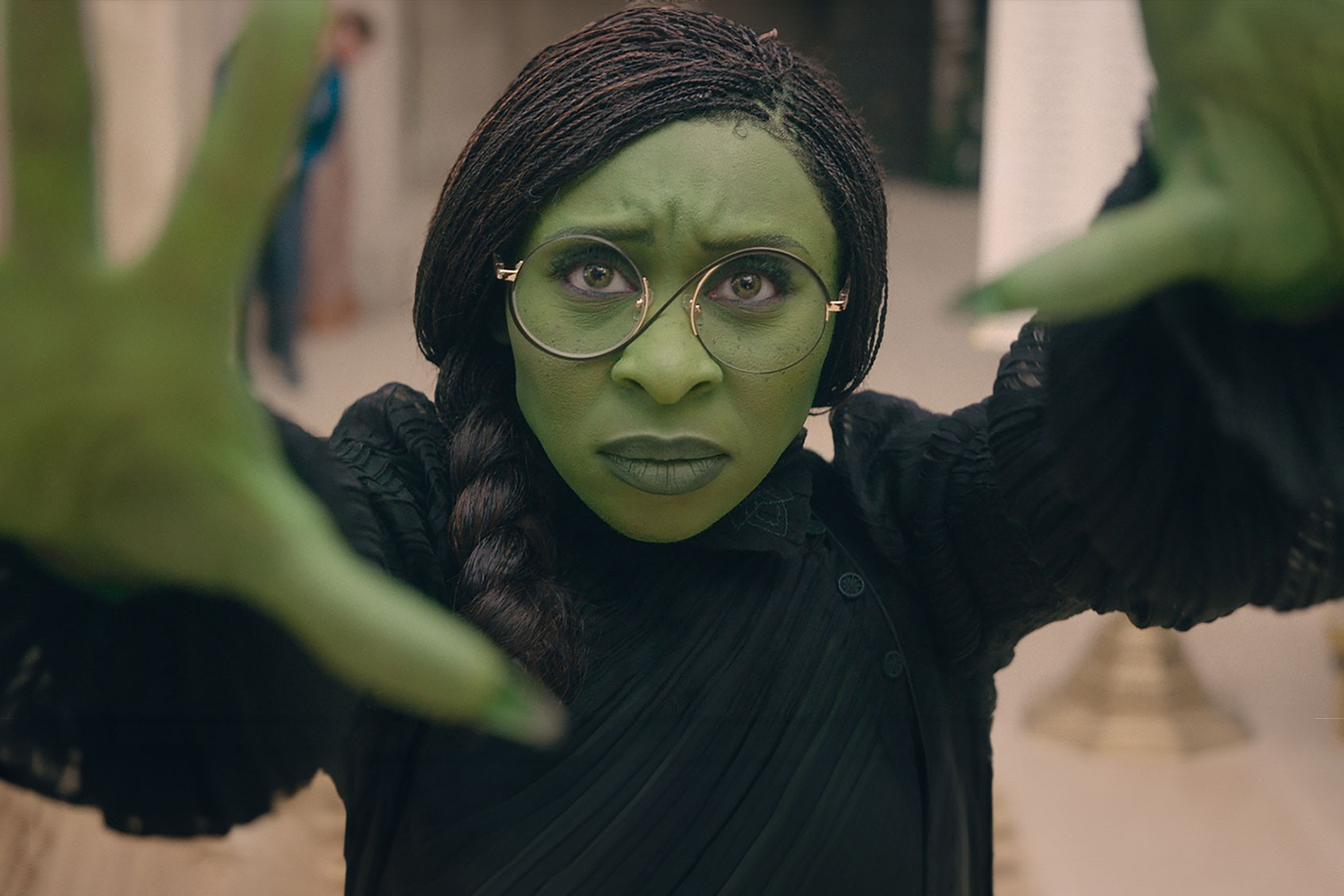
I'm sorry, bear?!?!?!
Why is-, I'm sorry, BEAR!?!?!? She's raised by a bear?!?!?!?!? That,- that can't be right? I know I never saw the musical, but....- (Google search)
Yeah, that's not in the play, or the novel it's based on; I knew that couldn't be right.
Okay, I came into this film, a little, conflicted, but also just tepid in general; like many other people "The Wizard of Oz" has fascinated me for years, but not exactly in the way that I think most people are. Most people think mainly of the classic MGM Hollywood musical, that turned Judy Garland into a superstar, and it's so inherently ingrained in our culture, especially American culture that like-, it's like the one old movie that's everybody's seen, even little kids have run into it at some point. I mean my mother once made a copy of it onto a blank VHS tape, along with "Mary Poppins" just so I would have an extra copy of it, and yes, I said extra copy, 'cause I already had a regular VHS copy, as she didn't even particularly like the movie that much. (Nor did she like "Mary Poppins" either, and frankly I'm not even particularly big on that one; I think even back then, when I finished watching "The Wizard of Oz" I usually just rewound the tape and put something else on, just so I didn't have to rewind it before watching "The Wizard of Oz" the next time I watched it.) But I really was fascinated by "The Wizard of Oz" after I read the original L. Frank Baum novel, "The Wonderful Wizard of Oz", or, I at least tried to. I've asked a few people who've also tried to read this over the years, whether or not they had a similar experience to me, and the consensus is that I'm not alone on this, but "The Wizard of Oz" is maybe the most convuluted book I've ever read! Or tried to read; I got pretty far, but I didn't finish it. It is different than the movie, in fact there's whole theories about the novel being a parable for the populism political movement of the late 1800s in America, that are genuinely also fascinating, and I don't know, they're worth taking a day to dive into, anything more than that I warn against, but it's kinda intriguing. That said, I'm not sure I buy that, because on top of the book itself being very,- convuluted, the franchise is actually even more elaborate....
Yeah, Baum didn't write just one book about Oz; he wrote about 40 of them! Okay, he really wrote fifteen, but there's books by other authors that canonical follow the Baum books, and that adds up to 40. Like, "The Wizard of Oz", was the premiere children's fantasy book series of it's time, like it's kinda in the same vein that we think of "Harry Potter" during it's prime-, I'd argue Harry was probably bigger, but, it's also in the vein as like, "Nancy Drew" where people kinda kept writing it even after it's original creator long stopped. "The Wizard of Oz" was big, and in fact, the MGM film was not even the first film adaptation of the novel, in fact there was at least three that we know of, and like two that have survived, including a 1925 feature length adaptation that's nothing like the book or the MGM film.
And here's the thing, "Wicked" came from none of these. It's not canonical to anything Baum-related, but most of the books are in the public domain now, and "Wicked" was originally a novel by children's book author Gregory Maguire, and it's technically influenced by the books, and even though there are canonical books in the franchise about the witches of Oz, I'd characterize the idea here, being mostly in the realm of fan fiction. In a way, it's a pretty influential book all things considered, not just 'cause of the huge Broadway musical about it; in fact, there's a lot of popular public domain Oz stuff, even in film and television; I think I'm the only one who liked that sci-fi channel miniseries "Tin Man" from a few decades ago, but taking the Wicked Witch of the West, and giving her a backstory and telling the story from her perspective-, it's hardly the first time the villain in popular literature has been re-positioned as a sympathetic antihero, but you can still make a pretty direct line between "Wicked" and say, Todd Phillips's "Joker" films or especially Disney's fractured fairy tale re-evaluation of the classic villains from their library, like "Cruella", "Malificent", "Descendants",- yeah, this probably started from "Wicked", or if not started, definitely was a major precursor to the trend, if not the major influence.
And I remember hearing about "Wicked" from the moment it hit Broadway so big; it's one of the biggest shows in my lifetime, and especially knowing that the main characters were played by Broadway greats Idina Menzel and Kristen Chenoweth,- I mean, I was definitely on board. (And I am happy they do have a number here in cameo roles) Eventually I borrowed the cast CD from the library, which in general, is something I recommend if you can. Even if you never see a musical on stage, or if they never adapt it to the screen, you can usually figure out enough clues from cast albums what the stories of some musicals are, and even if that's not the case, a lot of times the music's still good anyway, and I think it's an underrated way to explore theater. I of course love "Hamilton" for instance, but I also recommend "The Producers" cast album a lot; it's probably better than the movie. A couple others out there, "Fiddler on the Roof", "Guys and Dolls", etc.
(Sigh)
Anyway, I didn't like the "Wicked" cast album. In fact, I didn't like the music much, at all, from "Wicked". I listened to that album a few times and the only song I even really remember was "Defying Gravity", and even then, I- I wasn't as sure that it worked outside the musical, and that's when I really started digging into the dramaturgy of the musical, and-um,...- is "Wicked" actually any good?
Yeah, after hearing the music, the more I read about the actual play, the more concern I had. I was concerned from the original "Wicked" novel which was actually kinda mixed reviewed to begin with, but the-, the musical itself, also was kinda more popular than it was critically accalimed, even at the time. Even on Broadway, sometimes the biggest musicals you can think of were also not as beloved among the critics. Ask a person who knows Tonys history about the 1988 Musical race some time and be prepared to hear a few scathing remarks about how overrated a hack Andrew Lloyd Webber is, (and honestly I'm kinda on their side on that one; "Into the Woods" got robbed.) and "Wicked" is kinda also not beloved by the critics. (Actually the 2004 Tonys where "Wicked" lost to "Avenue Q", is also kind of a hot-button topic in those circles as well, so be careful, although we really should've gotten an "Avenue Q" film by now.) Like, I don't think it's hated exactly, but it's not exactly the most beloved musical, but again, a lot of the big ones aren't actually critical darlings, and that hardly matters on Broadway anyway.
Where it first kinda lost me, was, when I found out that "Wicked" was told in flashback.
I guess thinking it through it shouldn't have caught me offguard that much, flashback can be done on the stage and done fairly well, but the way "Wicked" introduces that conceit.... So, Elpheba (Oscar-nominee Cynthia Erivo) has been killed by an errantly-thrown bucket of water, and also the peoples of Oz are celebrating in glee. Galinda (Oscar-nominee Ariana Grande) leads in the admonishing, and tries to head off to oversee a new Oz governmental structure after the Wizard's (Jeff Goldblum) taken off, but then she's asked about how she knew her, and were friends with Elpheba. And that's how we get into, the story of their time at Shiz Academy together as sorcery majors.
I guess thinking it through it shouldn't have caught me offguard that much, flashback can be done on the stage and done fairly well, but the way "Wicked" introduces that conceit.... So, Elpheba (Oscar-nominee Cynthia Erivo) has been killed by an errantly-thrown bucket of water, and also the peoples of Oz are celebrating in glee. Galinda (Oscar-nominee Ariana Grande) leads in the admonishing, and tries to head off to oversee a new Oz governmental structure after the Wizard's (Jeff Goldblum) taken off, but then she's asked about how she knew her, and were friends with Elpheba. And that's how we get into, the story of their time at Shiz Academy together as sorcery majors.
(Deep breath)
I've thought about that being how the story begins forever, and, (Sigh) I'm sorry, that makes no goddamn sense. I was hoping it would work better seeing it here, in this long-awaited film adaptation of the musical, but why and how would somebody,- or so many people, not know that Galinda and Elpheba were already closely acquainted; this isn't even something hidden from the movie, this is like, made clear to begin with. Like, I know it's based on the books technically, but c'mon, if you've ever actually tried reading "The Wizard of Oz", you know nobody actually is inspired by them; they're influence and inspired by the movie first, and even in the film, clearly they'd been familiar with each other, long before they were in charge of their particular kingdoms, and even beyond, why would somebody suddenly pick that exact moment to ask Galinda about her past with the now-dead dictator?!?! Why would you,-, the way this should work, is that that's the last scene in story. Elpheba's dead and then somebody from whatever Oz's version of the labor-born comic relief side characters are, asks a conflicted Galinda about her past, and then she just acknowledges how they did know each other, once upon a time and how things went regretfully awry. The story should just begin with them meeting in school, it's much stronger that way?! The flashbucks screws everything up!?!?
Am I alone here?!- Am I off on th-, if you think I'm way off on this, like, fine, let me know, but other than to inform us that were in the world of Oz, which I legitimately don't think anybody needs to be informed about, I don't get telling this story in flashback, and I really don't get how they go about it. Like, this annoys so much that it would honestly take me out of the play immediately. Now whether I'd enjoy it anyway afterwards, well that's another thing, but yeah, since I wasn't huge on the music itself, I was worried going into this film version, which they decided to break into two parts? Hmmm, okay I know why they did that, but, well, should they have done that?
We'll get back to that eventually. First thing though, that I'm pretty taken aback by, actually seeing the movie now, is,- how much of a mean girl drama queen bitch they made Galinda. Like, I guess I get it,- actually does it make sense, on the surface, but-, hmmm. This is where I wonder if taking so long to adapt this hurt the film, because Kristen Chenoweth would've made this character work. In fact, I know she did, even seeking out a few old bootleg copies of the Broadway show and seeing only a few minutes of her, it's night and day, but on top of being a great comedic actress with a more operatic voice, her naturally pixie energy would take this kind of obnoxious character traits and still given her some likeability and charm. Grande, is a good singer and she's got some acting experience before this, but at least in this film, the role begins way too far off in the unlikable category, and it gets frustrating waiting for her to have her first real character growth. And that doesn't even happen 'til Elpheba convinces her teacher/mentor Madame Morrible (Michelle Yeoh) to accept her as a student, and this is after Galinda's been quite horrid towards her. She doesn't think she's being that way of course-, maybe Grande's just too pretty for this role; I know that sounds like a weird complaint, but she's nailing this character in a way where every nice thing she does seems like it's completely a backhanded compliment the way a really overly-beautiful girl teenage mean girl would, and I'm just not sure that's right for the future "Good Witch of the North". Okay, maybe it is accurate to some of the books but I don't know, I think I liked "Oz the Great and Powerful"'s interpretation of her a little better in this regard, where the Wicked Witch doesn't start out green with wickedness, but evolves into that over the period of events. Maguire wrote the novel more with an emphasis on the classic conundrum of nature vs. nurture and which one determines a person's qualities, especially ones that turn out so monstrously evil, which, ehhhh,- like that was an interesting, popular, theory for awhile, but even some of the best pieces of literature that have used that are often more camp now at best. I mean, I still love watching "The Bad Seed" whenever it's on, but I don't know,- it's pretty outdated. I mean, Galton was a eugenisist so, it's always been a sketchy theory even before fiction got ahold of it.
Cynthia Erivo is also kind of an odd choice here in the opposite end. Obviously, she also has a different singing voice, than Idina Menzel, but making her way too much the butt of the insult for having been born green, and then dismissed by her father, Governor Thropp (Andy Nyman) and raised by, in this film, a bear, Dulcibear (Sharon D. Clarke)-, okay that part's not in the play, in the books that's explained as a Nanny that raised her. Okay, the reason for this change, is that there's actually more talking animals in Oz than you might realize, and apparently there was a culture battle between the animals who could talk, many of whom were underlings and subserviant labor members of the classes and now they're being particularly ostracized. One of the professors, a goat named Dr. Dillamond (Peter Dinklage) is an animal rights activist who's secretly forming an underground political movement, and Elphaba's the only student who appreciates him and begins joining the cause and making her parent a bear, is-. okay, even saying this out loud, I'm still not sure that was needed. In fact, I'm kinda debating with myself on this one, whether Elphaba would be more empathetic to animals than humans. She has the trust of the monkeys, (Which, we do find out why) but they don't speak in the original movie. The Cowardly Lion speaks, so there's precedent for animals talking, there's trees who talk, are their any other animals who talk in the original "Oz"? I'm trying to remember. Then again, she hates Toto. Also, why would everybody be so prejudiced to talking animals? Man, the politics of Oz, like, in every reimaging I find, is just insane, really. How is it always about that too? Like there's no story about the average Munchkin's day as he tries to keep his job at the Lollipop factory, while his kid's going through a heroin withdrawal and his wife leaves him for his neighbor. God, the more these franchises go on, the more I wish Harvey Pekar was alive to create characters in them; I thought the MCU needed him, but maybe Oz needs him more.
Anyway, this is why "Wicked" is so strange, it's an adaptation of an adaptation of a reimagined prequel of an adaptation, from an original novel, but is more directed inspired by a previous adaptation that everybody knows, but they can't technically claim they're directly inspired from. It's the kinda stuff that makes me think that maybe we shouldn't let some things be in the public domain honestly. It's so far removed from it's original source that I kinda wonder why you wouldn't just create an entirely different world and set of characters altogether. (This is one reason I'm kinda on the right-wing's side on that, the argument that it's limiting creativity not having the ability to tell more creative stories by not having access to popular characters and franchises,-, like how? How is that naturally more creative? To take something that's already been created and then change it?! That sounds like the exact opposite of being creative, right? It's that kind of non-creative thinking that lead to people colorizing classic black and white films, or now, it's the people who use AI prompts to simulate artistic creativity now. [I'm generalizing of course, many things with pre-existing characters can be incredibly creative, including "Wicked", but it is a thought process that I can't fully get out of my head sometimes, and it's doing backflips in my head as I watch this film.])
So, other than all that, am I enjoying the play? Um, well, I'm still not totally impressed with the music. It's a little more helpful seeing it in a somewhat proper context; I do like "The Wizard and I" a little more now. And I enjoy "Sentimental Man" a bit more, especially with the inspired casting of Jeff Goldblum as The Wizard doing a very Chaplinesque performance of that number, that was a nice moment. Conceptually, I'm still questioning some of how we got here, but the best part of "Wicked" has always been the end of Act I, and the movie ends an intense act break, where finally Glinda, or Galinda, finally has a bit of a revelation about the world, but is still not nearly as emotionally outraged when she realizes the corruption at the top that's lead to the problems within Oz, and her ultimate villain arc begins, although, it still feels, a little way too much like I'm watching the opposite world version of the story. I guess Glinda turns into a real good witch and Elphaba becomes truly wicked later, or maybe this is the AXIS comics version of Oz.
I don't know, maybe I'll finish one of those bootlegs before I second act this. It's tricky, 'cause there's way too many songs in "Wicked," too many that aren't really that memorable or interesting, and yet it kinda does make sense to split this into two parts and cut nearly nothing, 'cause the clear best song and most memorable part of the musical is at the very end of the first Act. It does get me excited to see Act II, or "Wicked: For Good" as it got titled in the film world. "Wicked" was always been one those musicals whose great moments are so great that it completely overwhelms everything else about the musical; and the spectacle of a climax of Act I, is genuinely astounding, but man, everything else around it can range from mediocre to messy to completely misguided. I've said that I thought "Wicked" was one of those musicals that absolutely perfect to adapt to the big screen with a big-budget Hollywood musical epic, but there was always also a nagging part of me that thought that perhaps part of what really makes it special is seeing it on the stage; the theater can alleviate more story issues and concerns than any other medium; the immersiveness of it can hide a lot of flaws, I mean, how else do you explain how "Cats" lasted so long on Broadway?
"Wicked" ultimately comes together and the performances, especially by Erivo and Michelle Yeoh, I think really make this worth watching. It's tricky though, when you see something that's so familiar done differently, you can't help but to analyze every single decision that was made. Like making Elphaba's sister Nessarose (Marissa Mode) a parallygic; it makes sense, but it's still a head-turning decision. That one is in the play, but not in the novel, in the novel Nessarose has no arms, which, is also a little head-tilting, so.... (Shrugs) Of course, making a Nanny a bear,- like nothing's gonna top that, even a wolf doctor gets no reaction from me compared to that. We also do get a lion cub; I don't think we found a tiger of any kind yet.
The film was directed by Jon M. Chu, and he's been a mixed bag with adaptations. His last film was "In the Heights" which I did like ultimately, that's Lin-Manuel Miranda's other famous Broadway musical. He previously did "Crazy Rich Asians" which made my top ten list the year it came out. He also did a G.I. Joe movie, that "Jem and the Holograms" movie that apparently pissed off both fans and those who weren't fans of the original cartoon, which is pretty hard to do. He first broke out do the "Step Up" sequels, so I think he likes being more in the dance genre, so Broadway adaptations aren't a bad path for him, but I do wonder if he's only as good as however much he cares about what he's making. That said, there is a lot of care here in "Wicked" so that's at least honorable and worth a recommendation, but it is a mild one. I'm not sure I really enjoy "Wicked" overall, but despite my critiques, I can't exactly build up any disgust for it either. I have conflicted questions and views on the musical itself, so naturally I have them for the film, so all things evening out, I'm basically in the middle on this one, stuck at a yellow-bricked intersection trying to figure out what way the movie will go.
FLOW (2024) Director: Gints Zilbalodis
⭐⭐⭐⭐⭐
I've spent a couple days trying to figure out how to write about "Flow", and I'm still not sure how to fully approach this film. It's not that inherently unique necessarily, in fact, on the one hand, it's story it's painfully simple. It's about animals on a journey. I can think of a bunch of Disney films with the same basic idea, and yet, "Flow" is not like any of those. "Flow" is hard to describe in general,- well, that's not true exactly either; it's one of those rare amazing films where I could literally describe what happens, but explaining it is kinda defeating the purpose. This movie has to be experience, preferably on the biggest screen possible; if it's available in IMAX; hell-, screw "The Wizard of Oz", somebody put "Flow" in the Sphere, without any addition or edits that aren't approved by it's director, Gints Zilbalodis.
A loose expansion on his short film, "Aqua", "Flow" takes place, some future time on Earth, somewhere on Earth-, I think it's Earth. It looks like Earth, there's remnants of humanity but no humans, and clearly the world is post-apocalyptical. I say "remnants" because you're tempted to look at them as "Clues", like you're playing "Myst" and trying to figure out what exactly happened, but personally, I'm not even 100% sure that matters. If you want to dive into several theories there's plenty of other blogs and Youtube essays out there trying to come up with their own theories of the world of "Flow". I'm not even going to try pretend that any of them either know or are particularly close, what I know is that we're following a cat.
I don't know his or her name, I know it's a cat. Cat, is a cat. He's a loner cat. There's not a lot of other cats around, but there are other animals, and Cat is living in his refuge and is a scavenger, preferring to sneak and steal from other animals around than to fish in the nearby rivers and streams. He lives by an abandoned house and a giant statue of a cat. Why is there a statue of a cat? Clearly Cat didn't build it, by why did whoever built it, build it?
Dammit, I'm already caught up in questions,- that's the wrong approach to "Flow"; it's in the title, the movie flows, both your thoughts on the world, and the world literally, as the world that Cat and all the other animals surround is flooding, and flooding fast. Is it the return of the Great Flood, is it the original one? Did a dam break? At some point, we're on a boat. Cat, along with a Dog, a Labrador Retriever to be exact, who was separated from his pack, a solemn but steady Capybera, a frenentic Lemur who becomes obsessed with a mirror, and eventually a Secretarybird that was kicked out of his flock. And they're traveling on this boat? To where? Over there. Whatever, there eventually is.
According to Wikipedia, the film was made using Blender, which is already kinda stunning, but apparently it was also made without any storyboards, which-, I just-, no, I don't believe that. As somebody who doesn't like storyboarding at all, like, no, there's no way I'd be making this without storyboarding; if that's true, how is that possible. And how does look this amazing-, it's not just that it's the advanements of 3-D animation technical, people can use Blender and other similar free animated software and make some awful looking cartoons; this movie looks like it's a bunch of stunning water colors paintings come to life. I would've sworn that they at least did some variant of rotoscoping to get these animals to look and act so hyperrealistically, but apparently they didn't do that either. I mean, a lot of the issues with motion-capture performances has been how tough it is for it to make animal characters look and act like animals on screen. Like, once upon a time, Norman Taurag won a Best Directing Oscar for a film called "Skippy" because he made a movie with both a kid and a dog as a main characters; nowadays you would never think of giving an award like to whoever directed this generation's "My Dog Skip" or for a more interesting comp, "Homeward Bound: The Incredible Journey" but still trying to find that right part perspective of doing similar things in animation now, is gonna hard but this is one of those films that's even if the technology dated in like twenty years, it's still gonna look amazing and we're gonna get caught up and swept in this story.
The movie became the first Latvian film to ever get nominated for the Best International Feature Oscar and won Best Animated Feature, because the first non-Japanese foreign feature to win that category. The movie's already become a huge point of pride for the nation, there's already statues made in honor of it, and frankly, I completely understand that reaction. One of Zilbalodis's inspiration was the films of Jacques Tati, and this movie belongs in the conversation with something like "Playtime" which is a film you can watch dozens of times in different-sized theaters from different parts of the theater and see something different every time. I partially can't wait to see what else Zilbalodis makes, and I'm also a little terrified that he might never repeat something this special, but either way, I'm gonna be excited for whatever else he makes.
A REAL PAIN (2024) Director: Jesse Eisenberg
⭐⭐⭐⭐
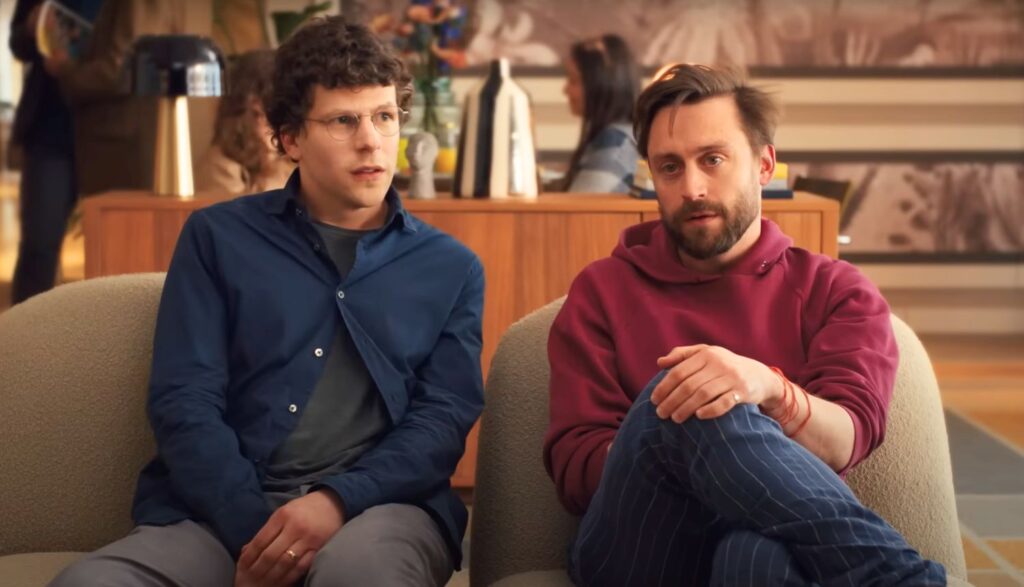
Hmm, I haven't run into this one in a while.... You ever have this, the "What-Is-Wrong-With-This-Person Movie"? The kind of movie where you're trying to figure out, what exactly is wrong with this character that you're observing, and you're, hoping to actually find that out. I say "hoping", 'cause sometimes these movies, well, they don't realize they're that kind of movie, and it's really disappointing when the movie, like doesn't have an answer at the end, and you're like, "Wait, did the movie not think there was something seriously wrong with the character?" Everybody's got their own, well, "favorite"'s the wrong word, but personal choice to use as an example, mine is "Spanglish"; I-, to this day, I have no idea what the hell Tea Leoni is doing or thinks she's doing in that movie, or what that movie thinks she's doing. You can also kinda use this to explain every Tennessee Williams heroine-, well maybe not Maggie Pontliff from "Cat on a Hot Tin Roof", but every other one of them. (BTW, IMDB.com, can you use a different photo of Elizabeth Taylor for her main picture; I don't need to look up her films that aren't "Cleopatra" and then see her headshot being her in "Cleopatra"; that's,- c'mon!) Anyway, I give those a tepid pass, because, well; psychological analyses wasn't as prescient and common back then, but when you see a modern film where clearly someone has some sort of psychoanalytical issue and it's like, not addressed-at-all,... ugh, cringe. It's the only word I can use here, it's cringe.
Honestly, it's kinda cringe even when the movie knows it's that kind of movie, but boy it is relief when the movie does actually, you know, realizes it. Thank fucking God, "A Real Pain" actually does know this. In fact, that's kinda the whole point of the film. Two cousins, David (Jesse Eisenberg) and Benji (Oscar-winner Kieran Culkin) meet at JFK before going on a Jewish Heritage Tour of Poland. Their grandmother Dory passed away recently, and believe this is the best way to honor her, as she was the family member who survived and escaped the concentration camps and made her way to America, and now that she's passed, they're going to seek out the house that she grew up in; the last spot the Kaplans were in Poland before she left. David lives in New York and has a wife and a kid, and a high-pressure job working on creating internet ad banners, but Benji has been a n'er-do-well as an adult, and mostly has remained in Binghampton on his mother's couch, and is otherwise just drifting aimlessly and erratically through life. For instance, when they arrive at the Hotel in Warsaw, a package of marijuana is there waiting for him. David's not opposed necessarily, but considering the trip, and how Benji's thinking of partying and getting high, it's a little awkward, but then again, the cousins haven't seen each other in a while, and don't hang out nearly as often as they used to. They're the same age and grew up together and apparently used to be much more similar, but adulthood has led them astray.
Benji, is naturally the more erratic one, sometimes very erratic, and his moods can switch on a dime. One moment he's having fun with the group, convincing them to take action-like photos in front of the Warsaw Ghetto Uprising Monument, but then freaks out at the cemetary over the tradition of putting stones on the grave and berates the tour guide, James (Will Sharpe) over his constant repetition of facts. He tries to get close to other members of the group, like Eloge (Kurt Egiyawan) a Rwandan Genocide survivor who converted to Judaism after he moved to Winnipeg and the Jewish community helped him acclimate, and even spends a night with Marcia (Jennifer Grey) a divorcee who's moving back to New York from L.A. Everyone's looking for something different in this trip, but if there is a common motivator, everyone's suffering through some kind of emotional struggles and pain, and are trying desperately to figure out how to cope with it. Benji's more outwardly expressive and emotional, letting all his emotions take over, while David has repressed a lot of his quiet desperations.
There's a scene at a restaurant where eventually, everything breaks down, and Benji ends up leaving the table for a few minutes, and the group begins talking about him. I won't give anything away, but Jesse Eisenberg, who has always been one of our great modern actors, I legitimately don't think he gets nearly the credit he deserves as an actor, both in general, and for this movie, because he gives a monologue about his cousin, that's just so amazing to watch and emotional, and does reveal the reason for the tensions between them that I will not reveal here, but, man-, people are crediting Eisenberg's writing especially for this film; he's been a successful short story writer and playwright outside of his acting work and he got an Oscar nomination for Writing this film, which he also directed, but I think it's actually his performance that made the film for me. I know that's weird, considering this film is basically a two-hander, and Culkin's character is the one getting all the acclaim and accolades, but I think Eisenberg's performance is a little more special honestly. It's more reserved, so at the surface he seems to be doing less, but that's why Eisenberg's such a great actor, I think of him as being Nicholas Cage-like in how eccentric he can be with all his choices, but Eisenberg knows how to play the inner struggles of his characters maybe better than anybody, and here, you can see the repression of his natural instincts, wanting to lay waste to the room the way Culkin can and does, but he knows he's not quite able to do it himself anymore and it's really special watching him work. A bad performance in that scene, could've absolutely tanked this movie, and made the film feel more indy and cliche and honestly could've made the script itself feels more average and even uninspired; it could've completely ruined the movie, and instead he absolutely nails the scene and ruins the audience.
That's nothing against Culkin's performance, in fact, if Eisenberg ever thinks of adapting "A Real Pain" into a play, I would love both these actors to perform on stage, but switch roles, and see how that would work.
I also love that there's no real resolution to their personal struggles, and also how they go about showing that, again without giving anything away, other than, they both come back home later, this movie gets that, one's problems, especially modern problems aren't going to be solved by one trip, or one hug from a loved one, or one slap from a love one even, or even trying to combat and contextualize your own struggles and pains to those around you, and looking at, or even trying to simulate their, real pains and struggles they went through, not that seeing the mostly untouched remains of an actual concentration camp won't effect you, it will, and it may put your hill of beans problems into perspective but it doesn't solve all your problems at home. "A Real Pain" can be a struggle to get through when you're watching it at times, but it's definitely rewarding to get through, even if sometimes it's still painful.
NO OTHER LAND (2024) Director; Yuval Abraham, Basel Adra, Hamdan Ballal & Rachel Szor
⭐⭐⭐⭐1/2

Masafer Yatta.
Look, I'm not gonna pretend I get every nuance, of-, well, anything involving the West Bank, pretty much. Trying to go online and decipher what exactly I'm watching being documented in "No Other Land", the Oscar-winning documentary about the area called, Masafer Yatta, (of according to Wikipedia, it's also called Mosafaret Yatta sometimes) honestly, I think there's far fewer in the West who really know what's been going on and why in the conflict than they want to admit, and I mean that for those on both sides of conflict, but I can tell when I'm watching a people suffering and being, repressed, or worst. Literally, in this film, I'm watching in some cases Palestineans getting killed by Israeli soldiers. Why are they killing civilians over this land? (Chuckled sigh) Well, I can start at the beginning with that guy named Abraham, but.... Masafer Yatta, is a municipality in the West Bank, which Israel, way back in the '70s, declared to be an Israeli Firing Zone.
Israeli Firing Zone, are these areas in the occupied West Bank, that's the Israeli-occupied areas that the Israeli military has been occupied since the Six-Days War, that they declared as space for them to specifically use for Military Training. I-, I'm trying to find some American military comparison, but I can't because, the ideas of these place is that their otherwise uninhabited stretches of land, used for military purposes, except, back when they declared Masafer Yatta an Israeli Firing Zone, there were about 5,000 Palestineans living there, and they're still there, and basically, they can be killed for being there, basically without punishment by the Israeli military. And that's been happening, and they do other things too, like evict them from property, destroy their houses and homes- eventually they're trying to eventually turn these into Israeli settlements....
Look, it's easy to joke about how complex this conflict is, or how old it is, or-, how dumb it is, or how both sides are awful,- and all that is true, but like, all this is, well-, it's all happening on a very small strip of land. This isn't a cold war between superpowers or anything, the country of Israel is, a strip of land smaller than New Jersey they're fighting over, any atrocity you hear about that's happening there is occurring down-the-road and across the street from the last atrocity. And determining who's "ultimately at fault"- well, that's the wrong way to look at it. The real way to even begin to analyze this conflict, is to look at each individual issue individually, and "No Other Land" is a look at that, and yeah, I know there some complaints that this was too bias or anti-Israel a perspective, but no, this one is clearly Israel's fault. They're an illegally invading force and the only thing that's probably stopping them from using the residents of this area as regular military target practice is that there's people with cameras around.
"No Other Land" was mostly shot by Basel Adra, a renowned Palestinean activist and photojournalist and he's been recording the Palestinean resistance to this Israeli's attempted forced displacement since he was a child. We see his cousin shot near the end of the film; that's not the first attempted murder by the Israeli forces we see; in fact, we see another one earlier that lead to his friend's paralyzation and eventual death, and cause his family to leave their home and hide in a nearby caves. The Palestineans aren't alone in their cause here either; the other journalist in the movie is Israeli journalist Yuval Abraham, and they're actually decent friends. Abraham's not ignorant of Israel's actions, but they're differing background do mean that they come from very different lives. That's something that I never think about with this conflict, is that, the Israeli occupation means that the Israelis are more well-off in the region while the Palestineans are often too poor to fully defend themselves. That resident that's paralyzed; he died because the displacement meant that he couldn't receive the proper medical care needed to survive. It's not simply a religious disagreement, the fight for control and power is about wealth disparagement, as well as a human condition disparagement.
Despite winning the Best Documentary Oscar, the film struggles to this day to be widely-available in America, and barely got a Oscar-qualifying theatrical release, partially due to the supposed controversialness of it's subject matter, and even streaming this film is difficult to find. I think to some anything that's anti-Israel is (finger quotes) "controversial". Look, I would not confuse "No Other Land" as a synecdoche for the entire conflict, even the conflict in it's current form; it's an intense look at one singular aspect to a larger conflict, and in this instance, it's clear which country's in the wrong. That said, when Basel's cousin was shot by an Israeli soldier, while he was defending his home, that even took place around the October 7 Attacks, the deadliest attack against the Jewish population since the Holocaust, and all told almost 1,200 people, most of which were civilians were killed in those attacks, that were mainly executed by Hamas. Maybe they do need land for military firing zones, but then again, do they need land that Palestineans are on? Even if they occupy the region? Is there really "No Other Land"?
I SAW THE TV GLOW (2024) Director: Jane Schoenbrun
⭐⭐⭐1/2

"I Saw the TV Glow" feels like a movie that, had I seen it at an earlier time in my life, I would've been really into it for a bit, but then, would've found it somewhat disappointing afterwords when I tried to revisit it.
That's partially a joke, admittedly, but-, hmm, well, first off, full disclosure, one of my favorite Youtubers is Pop Arena, run by the seriously underrated and underappreciated Greg "Gregifer" Stevens, and in particular his amazing series, "Nick Knacks" where he goes over literally every television show to ever air on Nickelodeon, and he spoiled a certain absurdist detail in "I Saw the TV Glow" that he mentions during his episode on "The Adventures of Pete & Pete", I won't spoil here, even though it doesn't spoil the film necessarily, but it was the kind of detail that let me in on what exactly to expect going into this film. This is why I hate trailers and shit like that; I like reviews but sometimes something comes up and particularly when something is a really inventive and creative mood piece like Jane Schoenberg's "I Saw the TV Glow", it means you're coming in with expectations, and I personally think that's not a great thing, and why I only ever advise reading/watching movie reviews before watching a movie, the good critics will not spoil anything that they don't need to spoil. (And if they do, there's probably a good reason,- unless you're maybe the late Rex Reed. [BTW, Burn in Hell Buddy; I hope Marisa Tomei dances on your grave in a red dress. [Mock thumbs up]) Still though, there's-, there's something to this movie that's got this vibe to it; this idea that somehow, in our own memory, we tend to put some substandard works of art on higher pedestals than they actually deserve.
Sometimes because we saw them as kids and didn't know better, other times because we thought they were decent but we didn't know quite how to read them yet so while they're still good, they're not actually as good as time goes on. Sometimes, well, there's something about the piece of art that's so intriguing and fascinating to us, that, perhaps we want to be better than they are so badly, that in our minds, we just simply make them better than they are. That third one,- me, being a constant critic for so long, has always kinda fascinated and worried me, on both ends.
For instance, there's a TV show that's at the center of "I Saw the TV Glow"; airing on the Young Adult Network, Saturdays at 10:30pm, which seems very late even for the mid-'90s, called "The Pink Opaque". They show clips and highlights of the series throughout the film, including showing a few opening credits which definitely looked a lot like those teenage drama aired on UPN and WB during the late '90s, back when I was a teenager, and was the target demographic for a lot of those shows, many of those big shows, especially if they had the phrase "Created by Joss Whedon" in the credits, were right in my age demographic, and back then and even now, I thought those shows were basically garbage. Granted, I was a TV historian even then, so I looked at something like "Supernatural" and wonder why the hell would anybody watch that when there's "The X-Files"-, which I didn't even like, but seriously, why is "Supernatural" so popular; it's terrible. It's just stupid "The X-Files" with good looking kids. But god, most of those shows, I can't understand how people watched them and took seriously, and put extra meaning into a lot of those series. Even today, there's some defenders of them; like "Veronica Mars", got a reboot, and as an avid Nancy Drew reader at that time, I have no idea why that show needed to exist, or be brought back. Those shows were not uplifting and back then I thought, that they talked down to their audience, of teens and kids instead of bringing them up, and I still do, and that's just insulting to me, but I'm getting off-topic. The thing is though, it can work the other way around too.
I fear some people don't get why "The West Wing" is the best show ever, because of-, well modern times have made us more cynical of politicians actually trying to make the world better, but also they don't realize that that's how the world should be, and that showing that, is just as important as showing the world for what it treacherously is sometimes. I have friends I respect who thought it was "Hammy", and I thought, "Yeah, you don't know what good is if you think that." And the show hasn't changed, in my mind, but there's definitely shows or movies or moments on television that for one reason or another sparked such a visceral reaction upon originally airing or seeing it, that you overrate it. You watch it now, and sometimes, the thing is off a little; it's not quite what you remembered. Our memory can fail us sometimes. Or to be more precise, sometimes our emotions, can fail our memory.
"I Saw the TV Glow" is about two teenagers who are fans of this TV show, "The Pink Opaque", Owen (Justice Smith) a quiet young man who struggles to understand the world of middle school in the mid '90s, who sees promos for "The Pink Opaque" on TV, but it airs too late for him as his bedtime is 10:15pm every night. He does befriend an outsider goth girl, Maddy (Brigette Lundy-Paine Jack Haven) who's a photographer that's obsessed with the series and begins taping the series and sneaking Owen episodes when he's unable to manuever his way into having a Saturday night sleepover at Maddy's house. Around the time of the show's cancellation though, Maddy suddenly completely disappears through unusual circumstances. Owen was supposed to go with her, but his mother Brenda (Danielle Deadwyler) gets sick and he feels regret for not being there.
Years later, she shows up again, mysteriously, and under a different name, "Tara", and now claims that, she and Owen have similar powers as the two main characters in the show, which involved two girls with psychic powers to connect with each other and fight off some distant villains and monsters that they happen to come across who are after them because of their psychic powers, and again wants Owen to come along with her on a journey in order to-, well, it's hard to explain, but she's under the belief that the TV show, itself has become so apart of her that it's cancellation has essentially killed her, and now she needs to enter a real Pink Opaque, in order to get a sixth season,- and-, (Sigh) okay, I'm just gonna,-, it's a trans coming out metaphor.
Well, I guess I did give up something, but y'know, honestly, I watched the movie and didn't fully get that the first time around, and needed it explained to me too, so maybe it helps, but it is, and yeah, that's-, something that is definitely more in the LGBT community, how a lot of these shows, have aspects that they relate so well to, because of their struggles to figure out who they are, they look for anything symbolically in media to help them explain it, and there was quite a bit of that in a lot of those television shows, including those ones that I despised. You see, just because I don't see anything in them, or believe they could've found the same/similar/better things in other shows, doesn't mean that it didn't effect others, even if it wasn't in the media itself. I think that's part of why I gloated so much when people figured out how much of a perverted sex pest Whedon actually was, 'cause I felt justified in that my reading of his material was correct, but my friends found things in it, that I didn't see, perhaps because they were looking for it, and it was ultimately close enough for them to fill in blanks that weren't there.
"I Saw the TV Glow" is basically a parable for this modern age of gender openness and awareness that's coming-of-age in a parasocial world. The movie was written and directed by Jane Schoenbrun, a trans director who previously was Dan Schoenbrun for a few shorts, and this is apart of her trilogy, with the previous film "We're All Going to the World's Fair", which I haven't seen it, and their next-, um, apparently novel, called "Public Access Afterworld". It's called the "Screen Trilogy". I'm gonna withhold on the entire trilogy of films, but "I Saw the TV Glow", definitely goes for this eerie vibe of trying to understand a world that you can't fully grasp.
The movie has a surreal tone in it's undercurrents, and- I guess it goes with that strange tone where the nineties couldn't figure out if it wanted to continue with the alienated misanthropic youth of the early nineties, with the more freewheeling later nineties, and just decided to let everything happen at once. Like, I don't know in what universe an arcade outlives a movie theater anymore, but it does in this world. There's also a helluva good soundtrack, the title is actually from a Sloppy Jane song, and Sloppy Jane, actually plays the song in the movie, along with Phoebe Bridgers, and kinda like an old music videos, song performances do interstitiallly pop up in the film as well, not just as background soundtrack.
Now, I'm not entirely sure it fully works as a narrative,- although I guess we've all had that weird friend from school who disappeared and went a little nutty afterwards, but the movie definitely aims for a tone, and-, I don't know, it almost works for me as a mood piece, but I can definitely see it working for somebody else. I don't know how it'll feel afterwards though; this movie feels like it's definitely for a specific audience that, I happen to at least-, if not be apart of, definitely a, tangentially aware of. It was released by A24, that independent movie label that, personally I worry is becoming a product that itself is getting to caught up in it's own cult of fans who are proudly way-too-appreciate of their works, often well-above the quality of their actual films, if only because it's like, the first new opening logo to a movie they recognize as being quality different entertainment. (Shrugs) Good luck with that, when I young that logo was Miramax, so,... well, see how well A24 ends up down the line, but maybe that's just the cynical me who has to travel a lot farther back than high school or middle school to truly regret liking a piece of media only to realize later how little they hold up now.
(Sighs)
I thought "Popples" was good when I was two; there, you happy?! Now, let it be.
LOVE LIES BLEEDING (2024)
⭐⭐⭐⭐1/2

Trying to describe this movie in terms of typical genre descriptors is a Herculean task. It reminds me of those genre packets that script readers would occasionally get to use for samples of literally every possible subgenre and trying desperately to put every one of them that counts into that small little line on your Reader's Report. That's nothing compared to actually explaining the events themselves, at least not without going too deep into pure deconstructism of just telling you what happens. Part of me just wants to knock the movie for constantly being so unpredictable; in fact I could make a pretty good argument that the film is underwritten, in terms of just giving these characters more elaborate backstories and details, but that would take away from the fact that despite everything, this movie is so mysterious. It's mysterious, it's sexy, it's romantic, it's violent,- it's all those things and more, and it's literally on steroids.
The movie begins with Lou (Kristen Stewart) a manager at a local gym, who seems to be the town's only lesbian, except for Daisy (Anna Barishnakov) a flaky manipulative ditz who's desperately in lust with Lou, even though Lou's not that interested, but I suspect when options are limited.... Daisy's got the kind of toxic personality where you know her overly cheerful and sensual demeanor is exactly the kind of temptation you stay away from, except if there's no other kind around. Thankfully, a hulked up loner, Jackie (Katy O'Brien), an inspiring bodybuilder comes into town and gets in a fight with one of the local gymrats and her and Lou hit it off immediately. She's a n'er-do-well traveler trying to get to a bodybuilding competition in Vegas and is hitchhiking and sleeping her way from town-to-town to make it there. She ends up with a temporary waitressing job at a diner/gun range owned by Lou (Ed Harris), Lou Sr., I should say, Lou's father, who's also the town's local mob boss. Lou and Lou Sr. don't talk with each other, and their history is fractured, (Although not because she's gay), but she remains in town to protect her sister Bethany (Jena Malone) who's got a very abusive husband, JJ (Dave Franco) and soon, he goes way to far.
Bethany's too in love and brainwashed to do anything, even after spending most of the movie in a coma, and both Lou's are still fighting about what exactly should happen next. Both of them know where all the bodies are buried, literally and figuratively, and...- man, trying to explain everything else from here. Like, I'm barely a third of the way through the film at this point, and I haven't even gotten into, what may or may not be a series of hallucinogenic body dysmorphia events that lead to one person dead, and at least one person in jail. There's also various hitmen characters, as well as an FBI agent, O'Riley (Orion Carrington) who's presence seems more as a threat than an active participant in anything.
The way this movie genre-hops makes the obvious comparison, especially for a film with a lesbian romance at the center of it to The Wachowski's debut feature "Bound", but even that film, which goes from erotic romance to gangster thriller to heist comedy feels like it's only coincidentally going through a few genres; this film seems to start with pulp, bring in everything else, and beats those genres 'til their turn into their own bloody pulp. The only thing consistent in this movie is that, I genuinely never knew what the hell was gonna happen next.
There's some really great performances here, especially by Stewart and O'Brien, and the film was directed by Rose Glass, the British director who's debut "Saint Maud" was a straight up disturbing horror movie about an overly pious religious zealot nurse who believed god possessed her to convert her dying patients; that movie was about a disturbing relationship between two women who express their desires through two severe extremes, and "Love Lies Bleeding" feels similar in that both women go to their own extremes to escape their life. Lou, goes for extreme minimalism, having sparse relationships with anybody, and barely keeping any mementos of her family's troubles, in an attempt to figuratively escape when she's not pulled back in to make sure it doesn't end in fiery demies. Meanwhile Jackie, literally running away, and obsessing over her body to become as strong and powerful on the outside so that whatever emotions she does have get repressed to the point where they eventually explode out of her when they eventually do come out, sometimes in violence, sometimes in-, well, other ways, and perhaps whatever she's ingesting into her body is eventually gonna force it's way out, whether she wants it to or not.
It's interesting seeing a film that goes to extremes, actually be sexy and romantic for once, which seems to be one of Rose's themes. "Saint Maud"'s devotion to God was itself practically an orgasmic pursuit for it's main character and here, it seems sex, especially about women of severely repressed emotional extremes can have outbursts that are just as explosive in and out of the bedroom, and make that connection seem natural for all involved. It turns this very typical gangster story essentially into a charcter piece romance, even as the movie insists on trying to push it's characters into the trappings of the genre; complete with femme fatales around every corner, bad guys protecting other worst guys, and all the other sex and drugs and guns you'd expect in a movie like this. I have no clue honestly if the film fully works; this is the kind of movie that has logic holes that you can stretch pretty far if you think about it long enough, (and I'm not entirely sure of the significance in specifically setting this film in the early '90s with bizarre radio choices of such things like George H.W. Bush's infamous crack cocaine address) but this is a film that you want people to see so you can talk to them about it, and it certainly deserves being talked about.
DAUGHTERS (2024) Directors: Angela Patton and Natalie Rae
⭐⭐⭐1/2

You know, about a third of the way through "Daughters", a documentary about men in prison and their young daughters who are struggling to deal with their father's being locked up on the inside, as touch as I was with the stories told by both, the fathers and daughters, and other loved ones, I couldn't help but wonder, what exactly any of these prisoners were in jail for? I mean, there was no talk about them having not done whatever they were accused of doing, no claiming of innocence, not from them, or from their families. As soon as I thought that, I heard one horrific story from the mother of a young girl named Raziah who said that this was the second time that she had to talk her daughter off the roof of the building, threatening to,- well, you can fill in the details. That, along with a lot of the other tales I was hearing made me wonder, well, maybe it doesn't matter why they're imprisoned, the big issue is that, they're not there right now for their child. I mean, it is a struggle; when someone who should be there, isn't, and growing up with that, whether you're a baby or a teenager or many points in-between, it effects you. Then again though, it's a mindset, isn't it.
If you're surrounded by parents or surrogates, who have nothing but contempt for your parent, whether he's in jail or not, or just anger that he's in jail and constantly struggling to live and raise one, maybe many kids, it could be the most innocent man in jail and you'd definitely think that his actions being in prison is simply a selfish act and one that will forever have treacherous effects on you. There are young girls in this film, some very young, I might add, who are really keenly aware of that fact, and yet, what would happen,- I'm not saying one of their fathers are innocent, but what if they're taught why they did what they did, and in a way, that, doesn't justify their actions, but that they can help you to understand what they did and why they did it? Would that make them, more sympathetic, better off, better understanding of why their situation is the way it is? Would they even be able to understand that kind of decision that young, or ever, or should they even?
I'm not looking for an answer to these querries by the way, I don't think there is one, not a good one at least, perhaps I'm just looking for a way to explain to a young girl, why they shouldn't jump off a building just because their lives are, (Sigh) not ideal, and that while yes, having had your father around could've very well made it better and easier, doesn't mean that you should be trying to end it all because all the struggles surrounding that fact that you have to go through,...-
Honestly, perhaps I'm just thinking this because I grow up with my father; he wasn't in jail or anything, he's still alive, fine and all, I still talk to him when I can, I just grew up with a single mother and while we occasionally struggled, for the most part, I didn't have any of these kinds of thoughts, but having a parent in prison is vastly different, and not remotely a comparable homelife situation to my own. So, for me, I'm not exactly sure why it's so important to these little girls to see their fathers at a father/daughter dance, but I do get why it's important to the fathers. This dance has apparently been around before, but Angela Patton, one of the film's co-directors, a local Richmond activist for At-Risk African-American girls, started expanding the Daddy/Daughter dance to prisons after a few of the girls at Camp Diva, a local camp for young girls in the Richmond area, had fathers who couldn't come because they were in prison. This was a way of bringing the dance to them. Fathers have to attend classes on parenting in order to be allowed to go to class, and those classes are more group discussions about the struggles of being, or trying to be a father while behind bars. How to stay in your child's life despite the impediment of prison. I didn't realize for instance, how expensive and elaborate a phone call to and from prison to others on the outside can be, which honestly is-, is a sympton of the privatizing and corporatizing of prisons that frankly shouldn't exist.
There's very little discussed in the film of what any of the father's are in prison for; it seems to barely matter, and I guess that's true enough, if you're out of someone's lives what different does it really make the reason, the struggle to stay in your daughter's life the best you can is gonna be real enough no matter what. "Daughters" is a nice glimpse at the struggles on the homefront involving the penal system. I don't think it's a complete picture, of course, but it's a good depiction of one attempt to help alleviate the struggles, just a tiny bit, and from what I can tell, the program's been pretty successful overall.
A TALE OF LOVE AND DESIRE (2021)
⭐⭐⭐1/2
So, there's a scene in a wonderful Cuban film called "Strawberry and Chocolate" about a friendship between a conservative Communist and a flamboyant gay artist, and it's a sequence where the artist is making the Marxist uncomfortable, and challenging his views on homosexuality, and one of the way is by showing some Marxist literature that Marx was indeed pro-homosexuality. Now, in reality Marx and Engers' actual text spoke pretty little of homosexuality in general, but mostly were against it, but it has been a debate with Marxist theorists basically since the Manifesto was written, but y'know, in Castro's Cuba, being gay was paramount to being a capitalist. That said, I thought of that scene during "A Tale of Love and Desire," a romance about a young Ahmed (Sami Outalbali) is confronted at a bookstore by a fellow student he's attracted to, Farah (Zbedia Belhajamor) who begins reading to him some very sexually explicit Arab literature from the 13th Century, literature that Ahmed is clearly uncomfortable with. The point of these two scenes are the same, that sexual repression and openness are themselves more fluid in any religious or governing system, but in "Strawberry and Chocolate" it was an attempt to open up a character's mind, (Also, we find out that it part that it was part of an elaborate rouse but by the time we find that out it's not important) while in "A Tale of Love and Desire", it's about the slow opening up of,- well, something else.
It's a little, cliche admittedly, but it's also kinda nice to see a romantic and sexy coming-of-age story about a boy who has sexual hangups and the attractive and-, well, not an (Finger quotes) "extroverted", extroverted girl, but more extroverted than the guy, who's willing and wanting to get him out of his shell. It happens that way sometimes, more than I think people realize. And yeah, this kind of relationship often starts with simple flirtatious discussions that often drift into sex, coming from the woman. Ahmed and Farah are pupils at the Sorbonne. Ahmed's lived all his life in Paris, but his parents were Algerian refugees. His father Hakim (Samir Elhakim) was a journalist once upon a time, and for the most part, their household seems fairly strict, although his younger sister, Dalila (Mahia Zrouki) seems slightly more rebellious. Ahmed's tried to keep to his more stringent family's expectation and the expectations of his Muslim upbringing, but Farah, who actually is from Tunisia, seems more open to the more modern and liberal ideals of expressing oneselves, including sexually that have long been prevalent in the literal City of Love. In reality, she's only had sex with one other guy, but you know, religious or not, even a mild case of madonna/whore syndrome is genuinely a bitch to get over.
All this is overlapping with their Arab literature class, taught by Prof. Morel (Aurelia Petit) and this is also, a point of note, how "love" can be taught differently through expression. There's a buildup to an oral report that Ahmed's supposed to give, and he interprets a poem as being about the longing and rejecting of one's desire, love from afar, while most people would interpret the poem as being much more personal and sensual in it's nature. They don't dwell on it, but who knows who exactly is right? Hell, one of my literature professors in college, her favorite poem was T.S. Eliot's "The Love Song for J. Alfred Prufrock", and I think she wildly misinterpreted that poem; even she noted that she wasn't in the consensus on it. It's one of my favorites too, but no pretty curly-haired woman ever opened up a book of poems and handed it to me that was written by some Arab poet from the 13th Century, so perhaps my view is bias.
There's also the hangups of culture, within a similar culture here. Even though, Ahmed is Algerian and identifies as such, he's not only never lived or visited the country, he can't even read or write in Arabic. When confronted about it, his father said that he didn't think it would be necessary or essential for him. Maybe it isn't, but it's one more loss thread for a man who's own culture is as far apart from him as the surrounding French culture is.
Also, it is nice to get a sexy Muslim film, and a nice one about romance. Perhaps it ending with, you know, being awaken by getting laid, is a little too on-the-nose, but how often is that the ending for a coming-of-age male story anyway? The film is directed by Leyla Bouzid, her second feature, and she is a Tunisian woman whose background feels achingly similar to Farah's. In fact, this is her second feature to have a main young woman character named Farah that's a curly-haired Tunisian young woman. It's interesting that she doesn't make it Farah's journey into eroticism, and instead shifts it onto the male character. Perhaps you can read criticism of the modern Muslim faith and teachings in this, or at least, what growing up in that world can lead to unneeded repressed feelings in boys, and probably most girls as well, but I enjoyed "A Tale of Love and Desire" best, as a story of one person's eventual understanding that they are indeed too separate feelings.


No comments:
Post a Comment